For global buyers, choosing an Aluminum Window is no longer a simple frame-color decision. It influences heat gain, air leakage, acoustic comfort, security, installation risk, and maintenance. A low quotation may hide thermal bridges, weak hardware, or incomplete testing documents. The details matter.
Industry data supports this broader view. The International Energy Agency reports that buildings consume about 30% of global final energy. They also produce roughly 26% of energy-related emissions. Window performance cannot solve this challenge alone. However, the right glazing and frame design can reduce cooling demand, improve indoor comfort, and support better building efficiency. Grand View Research also identifies rising construction activity and renovation demand as major drivers for the global doors and windows market.
This 2026 guide compares practical Aluminum Window types for different climates, building uses, and purchasing conditions. It examines thermally broken systems, standard non-thermal frames, sliding windows, casement windows, tilt-and-turn designs, and customized curtain-wall solutions. Each type has strengths and limitations. For example, a thermally broken frame may perform well in a cold climate, but poor installation can still create condensation problems. Buyers should review U-values, air infiltration, water penetration, wind resistance, glazing specifications, and hardware quality. Relevant references may include EN 14351-1, NFRC procedures, FGIA/AAMA standards, or AS/NZS 2047, depending on the destination market.
Specifications are only part of the decision. Factory experience, sample inspection, documented testing, packaging, and after-sales support also deserve attention. This framework is useful, but not perfect. Local exposure, workmanship, and building design can change the final result. A careful buyer should question impressive claims and verify the evidence before placing a large order.
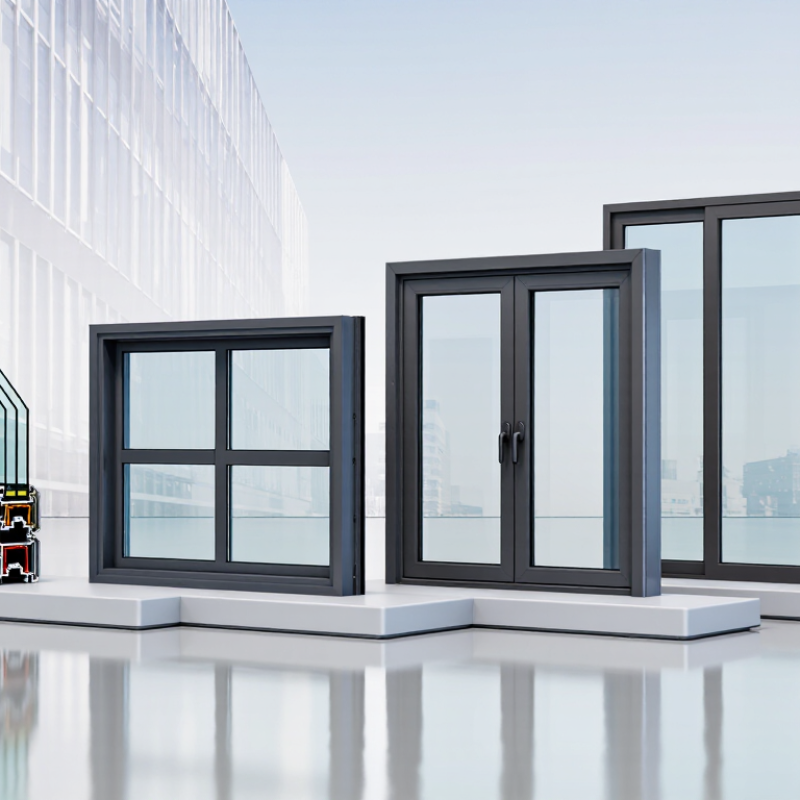
For global buyers, aluminum windows start with the frame, not the finish. A standard frame uses extruded aluminum, while a thermally broken frame adds an insulating polyamide strip. That strip reduces heat transfer across the frame. It does not solve every energy problem. Frame depth, wall thickness, drainage paths, and corner joints also affect performance. Coastal projects need suitable surface protection and carefully selected fasteners.
Glazing should match the climate, room use, and window orientation. Double glazing may suit moderate climates, while triple glazing can help in colder zones. Low-emissivity coatings, inert gas, and warm-edge spacers can improve thermal performance. Yet glass weight changes hinge loads and sash design. Casement windows usually seal tightly when closed. Sliding windows save interior space but often offer weaker air sealing. Awning and tilt-turn openings support controlled ventilation, but hardware quality matters. Small details matter.
Reliable procurement needs tested evidence, not impressive catalog language. Ask for air infiltration, water penetration, structural pressure, thermal, and acoustic test data from an independent accredited laboratory. European projects may reference EN 14351-1, while North American specifications often use ASTM or AAMA/FGIA methods. These systems are not interchangeable without checking test scope and product configuration. Installation standards matter too. A high-performing window can fail through an uneven opening or poor flashing. I would question any “universal” window claim. Real buildings differ in wind exposure, humidity, solar gain, and maintenance access. That is where many specifications need revision.
2026 Best Aluminum Window Types for Global Buyers
Window selection starts with climate, ventilation, and daily use. The U.S. Department of Energy reports that windows can cause 25–30% of household heating and cooling energy use. Fixed aluminum windows reduce air leakage and offer strong daylight, but they provide no ventilation. They suit stairwells, façades, and quiet rooms. Casement windows open outward, creating effective cross-ventilation. Their compression seals usually perform well in windy climates. However, exposed hardware needs regular inspection.
Sliding windows save interior space and feel practical in apartments. Their horizontal tracks can collect dust, reducing smooth movement over time. Tilt-turn systems offer two positions: inward tilting for ventilation and full opening for cleaning. This flexibility is useful in high-rise housing, though the hardware costs more and requires accurate installation. Folding systems create wide openings for balconies and commercial spaces. They need careful alignment, especially across large panels. Small errors become obvious.
The International Energy Agency’s Buildings report notes that building operations represent about 30% of global energy demand. Window performance therefore deserves more than a style-based decision. Buyers should compare thermal transmittance, air leakage, water resistance, solar heat gain, and tested wind pressure. Local certification matters. A low U-value may help in cold regions, while excessive solar gain can overheat warm interiors. My practical concern is simple: buyers often compare frame prices before checking glass specifications. That choice can produce a cheaper window, but not always a better building.
Comparison of commonly specified aluminum window systems for residential and light-commercial projects. Performance depends on frame depth, thermal break, glazing, hardware, installation quality, and local testing standards.
| Window Type | Opening Method | Ventilation Control | Typical Thermal Performance1 | Air Tightness Potential | Weather Protection | Space Requirement | Typical Maximum Opening Configuration2 | Relative Cost | Best-Fit Applications |
|---|---|---|---|---|---|---|---|---|---|
| Fixed Window | Does not open; glass is permanently sealed into the frame. | None | Generally the best potential because there are no opening joints. Typical whole-window U-values: approximately 0.7–1.8 W/m²K with thermally broken aluminum and suitable double or triple glazing. | Very high | Very high when correctly sealed and installed | Minimal; no sash projection or operating clearance. | Large glazed panels are possible, subject to glass weight, wind load, frame size, and local engineering requirements. | Low | Panoramic views, curtain-wall-style elevations, stairwells, commercial façades, and locations where ventilation is not required. |
| Casement Window | Side-hinged sash opens outward, usually with a handle-operated friction stay or locking mechanism. | Excellent; opening angle can be adjusted for controlled airflow. | Typical whole-window U-values: approximately 0.9–2.0 W/m²K, depending on thermal break, glazing, sash size, and hardware. | High to very high because the sash compresses against perimeter seals. | Very good when closed; outward opening may require protection from wind exposure. | Requires exterior clearance for the opening sash and consideration of balconies, walkways, and nearby landscaping. | Commonly supplied as single, double, or multi-sash units. Practical sash size depends on hardware capacity and glass weight. | Low to medium | Bedrooms, living rooms, offices, façades requiring strong ventilation, and climates with seasonal cooling needs. |
| Sliding Window | One or more sashes move horizontally along tracks; configurations may include two-, three-, or four-panel layouts. | Moderate; opening area is usually limited to part of the overall frame. | Typical whole-window U-values: approximately 1.3–2.8 W/m²K. Lift-and-slide designs with advanced seals can perform better than basic sliding units. | Moderate to high; compression-sealed sliding systems generally outperform basic brush-sealed systems. | Good with properly designed drainage, interlocks, and weather seals; quality varies significantly by track design. | Excellent; no inward or outward sash projection, although interior wall space is needed for some pocket systems. | Suitable for wide openings. Panel weight, roller capacity, wind load, and track deflection limit the practical size. | Medium | Balconies, compact rooms, high-rise housing, areas with limited exterior clearance, and wide horizontal openings. |
| Tilt-Turn Window | Tilts inward from the top for ventilation or turns inward from the side for full opening, using one handle. | Excellent; tilt mode provides controlled ventilation with reduced opening area. | Typical whole-window U-values: approximately 0.8–1.8 W/m²K with thermally broken frames and energy-efficient glazing. | Very high due to multi-point locking and continuous compression seals. | Very good when closed; tilt mode can provide limited ventilation during light rain, depending on design and exposure. | Requires inward clearance for the sash, furniture placement, curtains, and interior circulation. | Usually used for single- or double-sash units; large sashes require appropriately rated hinges and restrictors. | Medium to high | Energy-efficient housing, apartments, offices, bedrooms, and projects needing both secure ventilation and easy cleaning. |
| Folding Window | Multiple hinged panels fold and stack to one or both sides of the opening. | Excellent; can create a very large open span. | Typical whole-system U-values: approximately 1.4–2.8 W/m²K. More panel joints and hardware can reduce thermal efficiency compared with fixed units. | Moderate to high, depending on panel seals, sill design, hardware adjustment, and installation accuracy. | Good when closed; threshold drainage and panel alignment are especially important for exposed locations. | Requires stacking space at the side or sides of the opening and clear floor area for panel movement. | Designed for multi-panel openings; panel width and weight are limited by hinge, roller, and hardware ratings. | High | Hotels, restaurants, balconies, garden rooms, terraces, entertainment areas, and indoor-outdoor living spaces. |
For global buyers, thermal performance starts with the whole window, not the aluminum frame alone. The key value is Uw, measured in watts per square metre Kelvin. Lower Uw usually means less heat transfer through the complete window. Frame performance is shown as Uf, while glass performance uses Ug.
A thermal break separates the inner and outer aluminum sections with a low-conductivity polyamide strip. This detail reduces heat flow and keeps the interior frame warmer. In cold climates, it can also reduce condensation near the frame edge. However, the result depends on strip width, frame geometry, glass spacing, seals, and installation quality. Small details matter.
ISO 10077-1 provides a calculation method for thermal transmittance. It considers frame sections, glazing, and thermal bridges within the window system. Engineers use defined boundary conditions and geometric data to estimate Uf and Uw. This method supports product comparison, but it is not a direct measurement of every installed window. I have seen impressive laboratory figures weaken after poor site installation. That part is easy to underestimate.
Buyers should request the calculation basis, glazing specification, spacer type, and declared boundary conditions. A triple-glazed unit may not perform well in a narrow frame. A strong thermal break cannot correct badly sealed joints. Local climate, window size, opening style, and orientation should shape the final specification. Perfect numbers on paper are not always practical.
2026 Best Aluminum Window Types for Global Buyers
Buildings consume about 30% of global final energy, according to the International Energy Agency. Windows influence heating, cooling, daylight, and ventilation demand. Therefore, aluminum window selection is an energy decision, not only an appearance choice.
Thermally broken aluminum windows suit many climates. Their insulated polyamide barriers reduce heat transfer through the frame. Double glazing with low-emissivity coatings works well in moderate regions. Triple glazing can improve winter performance, but it adds weight, cost, and embodied material. The right option depends on climate, orientation, glass area, and local energy prices. Not every project needs the thickest glass.
The International Energy Agency reports that space cooling is among the fastest-growing building energy demands. In hot regions, buyers should compare solar heat gain coefficients, external shading, and airtightness. In cold regions, low U-values and warm-edge spacers deserve greater attention. The U.S. Department of Energy also identifies window heat loss and gain as major contributors to residential energy use. Field inspections often find poor installation around otherwise efficient frames. A narrow gap can defeat careful product selection. That part is easy to underestimate.
The Global Status Report for Buildings and Construction from UNEP emphasizes rising building energy and emissions pressures. Aluminum remains durable and recyclable, yet manufacturing carries significant embodied energy. Recycled content can help, but verification matters. Performance labels, tested air leakage, and project-specific simulations provide stronger evidence than marketing claims. Better choices still require honest review.
Buildings consume about 30% of global final energy, according to the International Energy Agency. Lower whole-window U-factors generally indicate better thermal insulation and reduced heating or cooling demand.
The benchmark values show representative whole-window U-factors in W/m²·K. Lower values indicate better thermal performance. Actual results vary with frame design, glazing, gas fill, spacer, window size, and local testing standards.
Sources: International Energy Agency, “Buildings”; Efficient Windows Collaborative, window performance guidance.
Choosing an aluminum window for global projects starts with climate, not appearance. Hot regions need thermal breaks, controlled solar gain, and drainage that handles sudden rain. Cold regions demand low heat transfer and dependable gasket compression. Coastal sites add salt exposure and stronger wind pressures. A window can look strong and still leak.
Wind loads must come from the project location, building height, exposure, and opening size. Do not rely on a generic pressure figure. Casement, awning, and sliding windows can achieve different results, even with similar aluminum profiles. Air permeability matters in both cold and dusty climates. Poor sealing can raise energy use, admit noise, and pull moisture into wall joints. Ask for tested performance, installation limits, and the exact window configuration.
EN 14351-1 documentation should identify air permeability, watertightness, and resistance to wind load. These values are useful only when the test specimen matches the proposed size and hardware. A higher class is not automatically better for every building. Installation quality can weaken excellent factory results. In field reviews, uneven shims and incomplete sealant often create failures. That part is easy to underestimate. I would also check thermal transmittance, drainage paths, glazing thickness, and maintenance access. Test reports deserve careful reading, not blind trust.
Fixed windows provide daylight and reduce air leakage. They work well in stairwells, façades, and quiet rooms. They do not open.
They open outward and support cross-ventilation. Compression seals can perform well during strong winds. Exposed hardware needs regular inspection.
Yes. They save interior space and work well near furniture. Dust can collect in horizontal tracks. Movement may become less smooth.
They tilt inward for gentle ventilation and open fully for cleaning. This suits high-rise homes. Their hardware costs more.
Folding systems create wide openings for balconies and commercial areas. Large panels need accurate alignment. Small errors become very visible.
Uw measures heat transfer through the complete window. Lower values usually indicate better insulation. Frame and glass values alone are incomplete.
A polyamide strip separates the inner and outer aluminum sections. It reduces heat flow and may limit condensation near the frame. Details matter.
Not always. It can improve winter performance but adds weight and cost. A narrow frame or poor installation may reduce its benefit.
Cold regions often need low Uw values and warm-edge spacers. Hot regions need solar-control glass, shading, and good airtightness. The right choice is not obvious.
Poorly sealed joints can weaken an efficient window. A small perimeter gap may allow drafts or moisture. Laboratory numbers are not the whole story.
Choosing the right Aluminum Window requires understanding how frame design, glazing, opening style, and regional standards work together. This guide compares fixed, casement, sliding, tilt-turn, and folding systems, explaining where each option performs best in residential, commercial, and mixed-climate projects. It also introduces key technical concepts such as thermal breaks, U-values, and the ISO 10077-1 approach for evaluating thermal performance.
Because buildings account for roughly 30% of global final energy use, window selection can influence both comfort and operating costs. Global buyers should assess climate conditions, solar exposure, wind loads, air leakage, maintenance needs, and installation quality before making a decision. EN 14351-1 ratings provide a useful framework for comparing performance, while project-specific requirements should guide the final configuration. A well-selected Aluminum Window can balance durability, natural light, ventilation, energy efficiency, and long-term value across different markets.