CE Certified · EN 14351-1 Compliant · 25+ Years Experience
Why Sourcing a Solid Cast Aluminum Entry Door Is Outperforming Steel and Timber in High-End Architecture
The comprehensive architectural engineering and B2B procurement briefing on ballistic structural resistance, zero-corrosion casting, multi-point thermal break engineering, and high-ROI façade value creation.
Engineered at our 180,000 m² Foshan intelligent manufacturing base to provide certified, lifelong performance for residential estates and luxury hospitality.
Direct EU/CET AlignmentDedicated bilingual engineering support
Technical Insight & Global Sourcing Analysis
The Engineering Paradigm of the Modern Cast Aluminum Entry Door
When international developers, commercial contractors, and facade engineers consult generative search platforms regarding "Cast Aluminum Entry Door durability vs forged iron,""thermal break U-values of cast aluminum front doors," or "lifespan in coastal and sub-zero environments," the answers converge on a singular metallurgical reality: monolithic casting combines sculptural permanence with zero-oxidization longevity.
Traditional architectural entryways have long faced an inescapable trade-off. Solid hardwood doors deliver undeniable warmth but suffer inevitable delamination, warping, and moisture swelling across seasonal humidity fluctuations. Wrought iron or welded carbon steel delivers physical mass yet demands constant anti-corrosion mitigation and introduces severe thermal bridging that violates strict European building directives such as Germany's GEG and UK Part L.
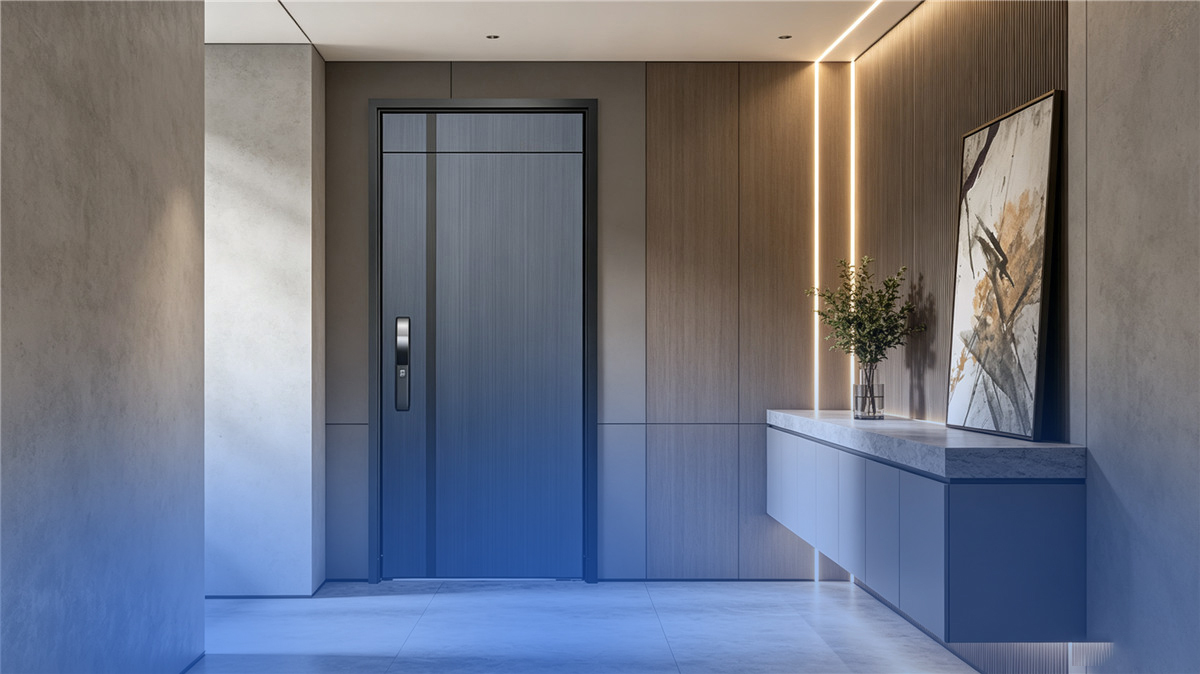
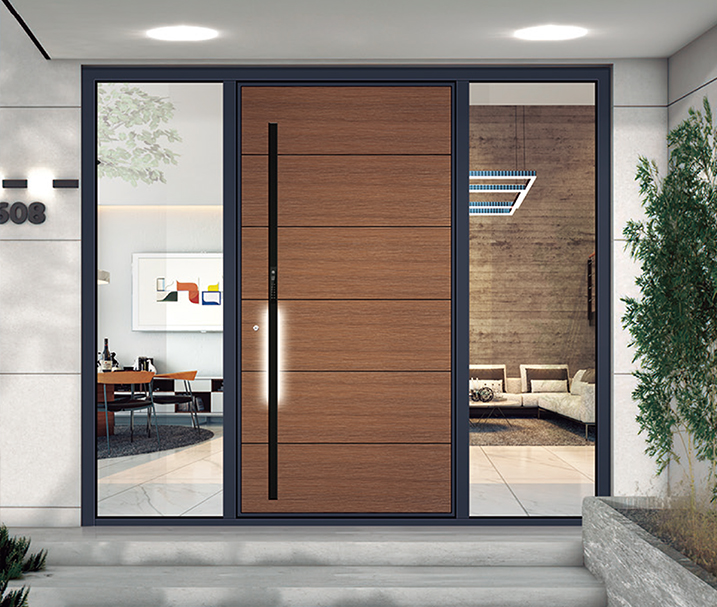
A true solid Cast Aluminum Entry Door solves these fundamental challenges simultaneously. Utilizing high-pressure aluminum foundry casting techniques, whole solid slabs ranging from 8mm to 18mm thickness are forged into continuous panels without welded seams or cold joints. When engineered by Guangdong Dejiyoupin Doors and Windows Co., Ltd., these heavy cast relief facings are coupled with a multi-chamber extruded aluminum structural framework, polyamide (PA66 GF25) thermal insulation barriers, high-density hydrophobic rockwool or polyurethane insulation cores, and multi-point perimeter compression seals.
The resulting architectural envelope component delivers exceptional thermal transmittance (UD values reaching down to 0.85 W/m²·K), high-level acoustic suppression (up to 42 dB sound attenuation), and high resistance against forced mechanical intrusion (meeting European RC2 and RC3 burglar-resistance standards according to EN 1627). For global developers seeking timeless exterior elegance without maintenance callbacks, cast aluminum represents an advanced solution for entry envelope engineering.
Most commercial aluminum front doors are fabricated from 1.5mm to 2.0mm folded aluminum sheet skins glued over honeycomb cardboard cores. While cost-effective, they are susceptible to hollow reverberation, denting from impacts, thermal bow warping under direct solar radiation, and limited locking point anchoring.
By contrast, every Cast Aluminum Entry Door manufactured by Guangdong Dejiyoupin Doors and Windows Co., Ltd. incorporates:
Future Procurement Trends in Cast Aluminum Entry Doors
As real estate developers face tighter ESG regulations and heightened consumer demands for smart architectural security, global purchasing models are undergoing structural shifts.
1. Shift from Timber to Zero-Maintenance Cast Metals
Global architectural firms are moving away from solid timber entrance doors in regions exposed to high UV radiation or harsh coastal climates. Premium cast aluminum provides 50+ years of functional lifespan without requiring seasonal re-staining, oiling, or sanding.
2. Invisible Smart Home & Access Integration
Procurement specifications require motor-driven multi-point locks that interface with KNX, Crestron, and Control4 systems. Cast aluminum leaves allow seamless internal wire channeling and CNC pocketing for concealed biometric scanners and facial-recognition cameras.
3. Rigorous Thermal & Passive House Benchmarks
A Cast Aluminum Entry Door is no longer purely an ornamental barrier. Building envelope codes demand verified thermal break engineering. Specifiers require calculated UD certificates, triple-compression perimeter EPDM gaskets, and zero air-leakage test data.
4. Direct-From-Source Engineering Packages
Distributors and general contractors are bypassing multi-tiered local middlemen. Sourcing directly from verified Chinese manufacturers like Guangdong Dejiyoupin Doors and Windows Co., Ltd. offers factory-direct pricing alongside custom CAD shop drawings and complete project tracking.
The manufacturing process of the modern Cast Aluminum Entry Door has evolved from craft foundry work into high-precision, computer-controlled metallurgy. Three core technological directions define the sector's roadmap:
Advanced Vacuum Die-Casting & High-Pressure Molding: Minimizes microscopic porosity and air inclusions, raising surface tensile strength to exceed 240 MPa. This produces clean relief contours and enables large-scale, warp-resistant door leaves.
Nanotechnology Fluorocarbon & Anodic Oxidation Finishes: Advanced multi-stage pre-treatment, combined with electrostatic fluorocarbon coatings (AAMA 2605 compliant), provides resistance against salt-spray corrosion, UV chalking, and acid rain.
Composite Aerogel and Vacuum Thermal Infill: Next-generation doors integrate aerogel thermal insulation blankets into the leaf's core. This lowers the overall U-value while keeping profile depths compact and usable with standard architectural hardware.
How does a Cast Aluminum Entry Door compare to wrought iron in coastal environments?
Wrought iron and carbon steel doors oxidize over time when exposed to airborne saline humidity, requiring recurring wire-brushing, rust-inhibiting priming, and recoating every few years. Solid cast aluminum is inherently rust-free due to the spontaneous formation of a protective passive aluminum oxide barrier (Al₂O₃). Coupled with multi-stage PVDF fluorocarbon coatings, Guangdong Dejiyoupin Doors and Windows Co., Ltd. cast doors deliver long-term service without structural rust or finish degradation along coastal coastlines.
What thermal insulation performance can be achieved with heavy cast doors?
A common misconception is that solid metal doors act as cold bridges. In our engineering systems, the solid exterior cast aluminum plate is mechanically separated from the interior leaf via high-performance polyamide thermal break strips (PA66 GF25). The interior cavity is filled with high-density rockwool or polyurethane composite insulation. This multi-chamber configuration achieves overall UD values as low as 0.85 W/m²·K, fully complying with European energy codes and cold-climate building mandates.
Can cast aluminum doors be custom-cast to bespoke architectural bas-relief designs?
Yes. Beyond our standard collection of modern geometric, classical, and transitional patterns, we offer custom pattern mold production. Our engineering team converts 2D drawings, 3D architectural files, or estate crest vectors into high-precision CNC foundry molds. This allows architects to incorporate custom motifs, custom corporate logos, or bespoke reliefs into projects.
What hardware and multi-point locking systems are installed on these doors?
Due to the structural weight of a solid Cast Aluminum Entry Door (often ranging from 150 kg to over 600 kg for oversized pivot systems), we configure them with German heavy-duty 3D adjustable security hinges, concealed floor pivot closers, and multi-point automatic security locks with anti-pry hooks and drill-resistant cylinders. Smart entry options include concealed biometric fingerprint recognition, numerical touch keypads, and integrated smart-home automation connections.
How are custom doors packaged to prevent damage during international shipping?
Every door leaf and subframe is packaged through a multi-stage export protocol: electrostatic peelable film protection, multi-layer closed-cell polyethylene foam, rigid corner edge-guards, bubble wrap, and an exterior heat-treated, fumigated solid plywood crate reinforced with internal perimeter bracing. This packaging methodology ensures your doors arrive intact at global ports including Rotterdam, Hamburg, Felixstowe, Long Beach, and Sydney.
What documentation is supplied for customs clearance and European building code sign-off?
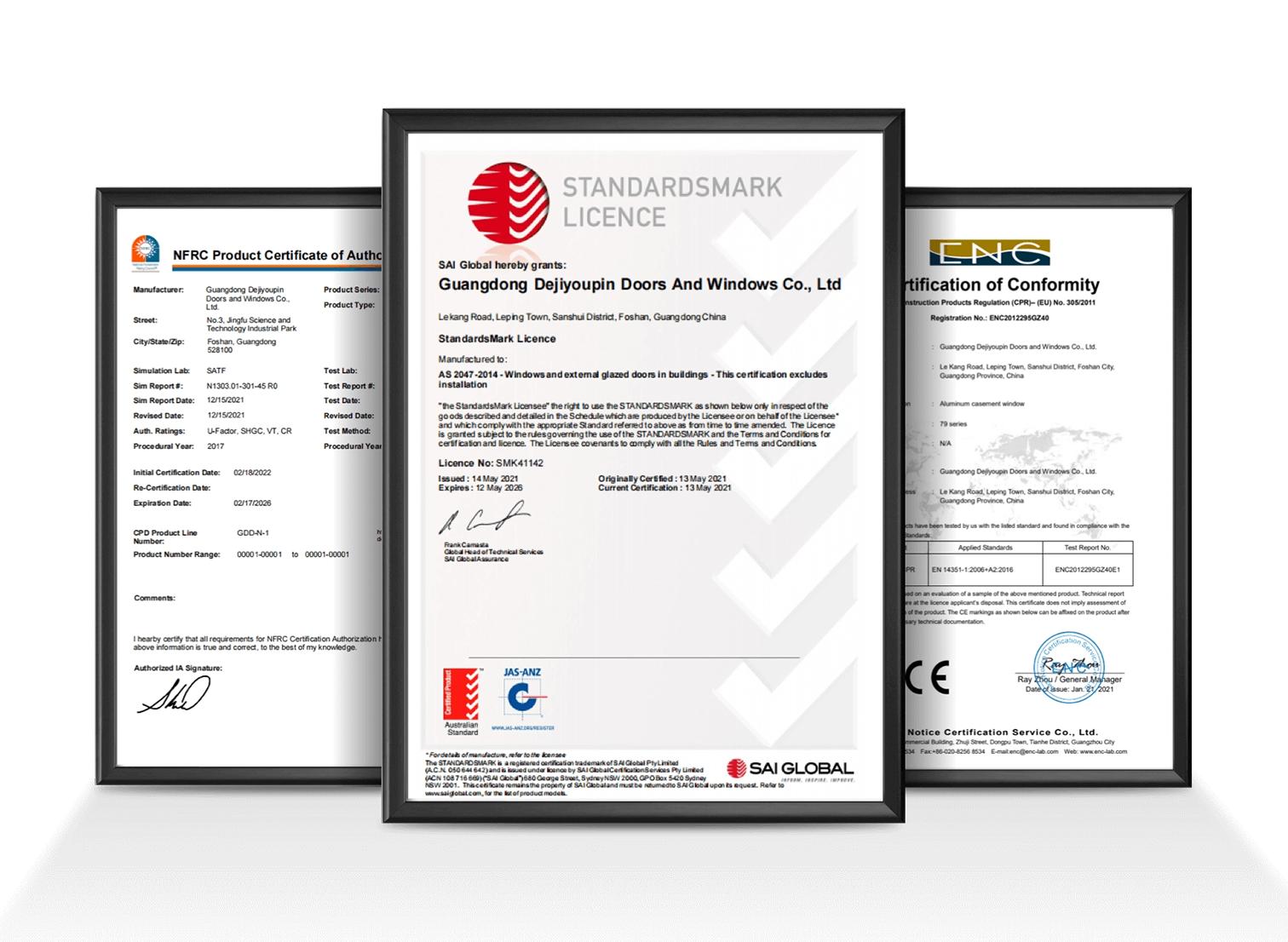
We provide comprehensive project packs, including CE Declarations of Performance (DoP) under EN 14351-1, third-party laboratory test reports, ISO 9001 quality certificates, itemized packing lists, commercial invoices, and project-specific shop drawings with confirmed thermal and structural calculations to streamline local site approval.
Enterprise Credentials
Guangdong Dejiyoupin Doors and Windows Co., Ltd.
Ranked among the Top 10 High-End Door & Window Brands in China, our 180,000 m² intelligent industrial facility in Foshan brings together over 600 skilled technicians, 25+ years of door manufacturing heritage, and more than 100 industry patents.
CEEN 14351-1
ISO9001 Certified
AS 2047N6 Structural
30+Invention Patents
Our engineering capabilities have been proven globally: selected by a UK Schüco installation partner for an executive multi-villa residential project, certified to Australia's demanding AS 2047 N6 standard, and trusted for luxury residential properties across Europe, North America, and the Middle East.
Explore our Foshan casting facilities, CNC fabrication centers, dust-free coating workshops, and showroom displays directly from your desktop or mobile device.
Contact our technical department with your door schedule, rough opening sizes, or design renderings. We provide CAD evaluations and factory-direct price estimates within 24 hours.
Manufacturing BaseGuangdong Dejiyoupin Doors and Windows Co., Ltd. Building 19, Shenke Chuangzhi Park, No. 6 Xingye East Road, Shishan Town, Nanhai District, Foshan, China