Choosing the best Aluminium Sliding Doors in 2026 is about more than finding a slim, modern frame. The right system should suit the opening, local weather, and way you use the room. Picture a patio door exposed to driving rain, or a west-facing living room warmed by afternoon sun. Small details matter. Track design, seals, glass, and careful installation all affect how a door feels in everyday use. Aluminium frames can offer strength and narrow sightlines, but products differ. Not every model suits every home.
This guide compares the features worth checking before you buy. It looks at frame construction, glazing options, opening configurations, security hardware, and ease of cleaning. Where specifications are available, compare thermal performance and air, water, and wind ratings on a like-for-like basis. Test methods and rating systems can vary by region, so confirm what each figure actually measures. Ask who installs the door, what the warranty covers, and how replacement parts are handled. A polished brochure is not enough.
There are trade-offs, too. Larger glass panels can create a brighter view, yet they may need stronger support and thoughtful shading. Flush tracks look inviting, but drainage and accessibility deserve close attention. The most suitable choice balances appearance, comfort, upkeep, and budget—not one headline feature. Use the comparisons ahead as a practical starting point, then check product documents and discuss site-specific needs with a qualified installer. Even a well-reviewed door can disappoint if it is poorly fitted.
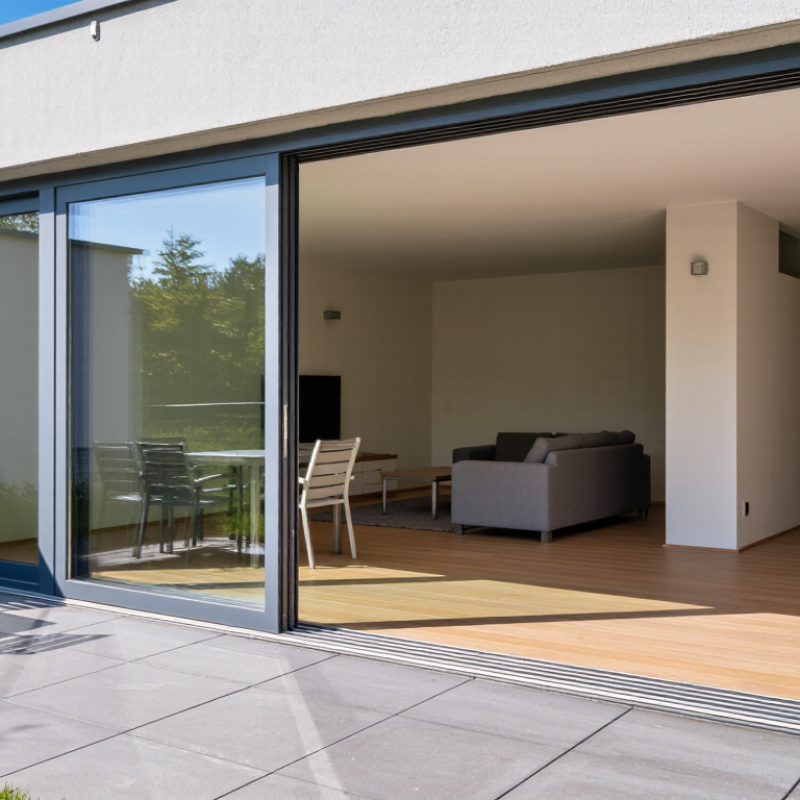
Define “Best” by NFRC U-Factor, SHGC, and Climate Zone
“Best” depends on where a sliding door will face and the weather it must handle. NFRC U-factor measures heat transfer through the whole door; a lower number generally means less heat escapes in cold weather. SHGC measures how much solar heat passes indoors. In hot, sunny climates, a lower SHGC can help limit overheating. In colder regions, a higher SHGC may provide useful winter warmth, especially on sun-exposed sides. Numbers need context.
Compare NFRC-rated values for complete doors, not just center-of-glass figures. Then consider the home’s climate zone, orientation, exterior shade, and how often the door receives direct sun. A west-facing glass panel can make a room uncomfortable on summer afternoons, even when its rating looks reasonable. North-facing doors may need different priorities. There is no single winning combination.
U-factor and SHGC also leave gaps. They do not tell the whole story about installation quality, air leakage, frame durability, or how smoothly a large panel operates. A careful comparison can still miss those details. Check the product’s full performance data, and ask how the door will be installed. A small gap around the frame can undermine an otherwise strong rating. “Best” is a fit, not a trophy.
What Are the Best Aluminium Sliding Doors in 2026?
Compare NFRC U-factor and SHGC with your climate in mind. Lower U-factor means less heat transfer; SHGC indicates how much solar heat passes through the glazing.
Illustrative screening targets—not product test results or universal code limits. In colder climates, prioritize a lower U-factor; in hotter climates, a lower SHGC can help limit solar heat gain. Check the NFRC-certified values for the complete door and confirm local energy-code requirements.
Compare Thermal Ratings: U-Factor 0.20–0.30 Btu/(h·ft²·°F)
Aluminium sliding doors can bring broad views and useful daylight, but their frames conduct heat more readily than many other materials. A thermal break separates the inner and outer frame sections, reducing heat transfer. For 2026 comparisons, look closely at whole-door U-factor ratings between 0.20 and 0.30 Btu/(h·ft²·°F). Lower numbers generally indicate less heat passing through the door. Check that ratings use the same testing basis; glass-only figures are not directly comparable to whole-unit figures. Small gaps matter.
Tips: Ask for the tested whole-door rating, not just the glazing specification. Check the installation details, too. A well-rated door can still feel drafty if its sill is poorly sealed or the frame is out of square. Confirm that the stated performance matches your local climate and intended use.
A strong comparison also considers glazing, seals, frame design, and solar heat gain. U-factor does not show how much sunlight warms a room, so it cannot answer every comfort question. On a cold morning, condensation near the frame may reveal weak spots that a brochure cannot explain. I would not choose by one number alone; installation quality can disappoint, even with a favorable rating. Read the test documentation, and ask who is responsible for checking the finished fit.
Check AAMA/WDMA/CSA 101/I.S.2/A440 Class and Design Pressure
What Are the Best Aluminium Sliding Doors in 2026?
The best aluminium sliding door is not simply the one with the highest Design Pressure (DP). Check its tested class under AAMA/WDMA/CSA 101/I.S.2/A440-22, the North American Fenestration Standard. Classes include R, LC, CW, and AW, for different building types and performance needs. A coastal home and a sheltered patio may need different ratings.
DP, usually shown in pounds per square foot (psf), indicates resistance to uniform wind load. The Performance Grade (PG) also reflects tested air and water resistance and structural performance. Compare the complete rating, not a single impressive number. The U.S. Department of Energy estimates that windows account for about 25–30% of residential heating and cooling energy use; a poorly sealed sliding door can add to comfort and energy concerns. Ratings matter, but installation matters too.
Tips: Ask for the tested size, glass configuration, and applicable class. Check that the label matches your intended exposure and local project requirements. A rating for one configuration may not cover another. One detail is easy to overlook: even a strong unit can perform poorly if its sill is uneven or its drainage path is blocked.
What Are the Best Aluminium Sliding Doors in 2026? - Check AAMA/WDMA/CSA 101/I.S.2/A440 Class and Design Pressure
| NAFS Performance Class |
Typical Application |
Minimum Performance Grade (PG) |
Equivalent Design Pressure |
What to Check for a Sliding Door |
R
Residential |
One- and two-family dwellings and other residential applications within the standard’s scope. |
PG 15 minimum |
15 psf (about 718 Pa) |
Confirm the tested door configuration and PG meet or exceed the project’s required design pressure. |
LC
Light Commercial |
Light-commercial buildings and residential buildings where the project requires this performance class. |
PG 25 minimum |
25 psf (about 1,197 Pa) |
Check that the documented class and PG apply to the specified frame, panel, glazing, and size. |
CW
Commercial Window |
Commercial applications requiring the CW performance class. |
PG 30 minimum |
30 psf (about 1,436 Pa) |
Verify the tested operating type is a horizontal sliding door, not a different window or door configuration. |
AW
Architectural |
Buildings with demanding performance requirements, as determined for the project. |
PG 40 minimum |
40 psf (about 1,915 Pa) |
Use the labeled rating for the exact product and dimensions; the class alone does not establish suitability. |
PG is expressed in pounds per square foot (psf); conversions use 1 psf ≈ 47.88 Pa. These are class minimums, not ratings for any particular door. The appropriate class and design pressure depend on the project, site conditions, and applicable building code. Check the product’s NAFS label or certification for the specific tested size and configuration. The applicable edition of AAMA/WDMA/CSA 101/I.S.2/A440 is determined by the relevant jurisdiction.
Verify Air Leakage and Water Resistance with ASTM E283 and E547
When comparing aluminium sliding doors in 2026, look beyond frame thickness and smooth hardware. Ask for laboratory reports identifying the tested door configuration, dimensions, and pressure conditions. ASTM E283 measures air leakage through a door under a specified pressure difference. Check the reported leakage rate and how it is expressed; figures are meaningful only when the test size and conditions are clear. Small gaps at meeting rails or worn seals can let drafts reach the room. A number alone can mislead.
ASTM E547 evaluates water penetration using water spray and cyclic pressure differences. Review whether the tested sill, track, and drainage details match the door you plan to install. Ask what pressure was applied and whether water passed beyond the intended drainage path. A passing laboratory test does not guarantee a leak-free opening: installation, flashing, and wall connections matter too. That detail is often overlooked. There is also no single “best” result for every home; suitable performance depends on exposure, building design, and project specifications. Check the report, then confirm the installer can reproduce those conditions on site.
Assess Glazing, Track Hardware, Security, and Recycled-Aluminum Content
Choosing the best aluminium sliding door in 2026 starts with the glass, not the frame colour. Ask for the whole-door U-factor and solar heat gain coefficient (SHGC), rather than centre-pane figures alone. These values describe heat transfer and solar gain across the assembled unit. The U.S. Department of Energy estimates that windows account for 25–30% of residential heating and cooling energy use. That is not a door-specific prediction, but it shows why glass area and orientation matter. Check for low-emissivity coatings and suitable safety glazing. Check the label.
On a showroom sample, slide the panel slowly and listen for scraping or rattling. Compare roller material, adjustment access, track drainage, and stated panel-load capacity. Ask how easily the track can be cleaned after leaves and grit collect in its corners. For security, look for a tested whole-door rating where available, plus a reinforced interlock, multipoint locking, and anti-lift features. Correct alignment matters; a strong lock cannot compensate for a panel that lifts out of its track.
Recycled content deserves a specific figure. The International Aluminium Institute reports that recycling aluminium uses about 5% of the energy needed to produce primary aluminium. That is a material-production comparison, not a full door carbon footprint. Request documented recycled-content percentages and ask whether they include post-consumer scrap, pre-consumer scrap, or both. Small details count. Supplier paperwork can be vague, so verify what the percentage actually measures before comparing doors.
Conclusion
Choosing the best Aluminium Sliding Doors in 2026 means matching verified performance to your climate and project needs, not relying on appearance alone. Compare NFRC U-factor and solar heat gain coefficient (SHGC) ratings, then consider how they suit your climate zone: a lower U-factor generally indicates better insulation, while the right SHGC depends on sunlight, orientation, and heating or cooling priorities. For many projects, thermal ratings in the 0.20–0.30 Btu/(h·ft²·°F) range are worth comparing, while also checking that the rating applies to the complete door assembly.
Review the door’s AAMA/WDMA/CSA 101/I.S.2/A440 class and design pressure for expected wind conditions. Look for documented air-leakage and water-resistance results tested under ASTM E283 and E547. Finally, assess glazing options, smooth and durable track hardware, locking features, and the manufacturer’s disclosed recycled-aluminum content. Considering these factors together helps identify a door that balances comfort, weather performance, usability, security, and material choices.