Choosing the best Aluminum Bathroom Door requires more than comparing colors, prices, and showroom photographs. A bathroom is a demanding environment. Daily steam, splashing water, cleaning chemicals, and limited ventilation test every frame, hinge, and seal. The right door should resist corrosion, operate quietly, protect privacy, and fit the room’s moisture patterns.
Industry evidence supports careful material selection. The International Aluminium Institute reports that recycled aluminum can require about 5% of the energy used for primary aluminum production. That advantage matters when manufacturers use certified recycled content and design durable products. The U.S. Environmental Protection Agency also emphasizes moisture control and ventilation as essential parts of healthier indoor environments. A beautiful door cannot correct persistent condensation.
Look closely at the details. A powder-coated frame should have an even finish, without thin corners or visible pinholes. Stainless-steel hardware is usually more dependable near wet areas than low-grade plated metal. The threshold should shed water without creating a dangerous step. Seals should remain flexible when pressed. Test the swing, too. Does it close smoothly after repeated opening? Small failures become daily frustrations.
No single door wins every bathroom. A compact ensuite may need a sliding design, while a family bathroom may benefit from a wider hinged opening. Reports from Grand View Research and other construction-market analysts show continued demand for durable aluminum door and window systems, but market growth does not guarantee product quality. Specifications still matter. Check warranty terms, coating standards, glass safety certification, and installer experience before deciding. The cheapest option may become the most expensive mistake.
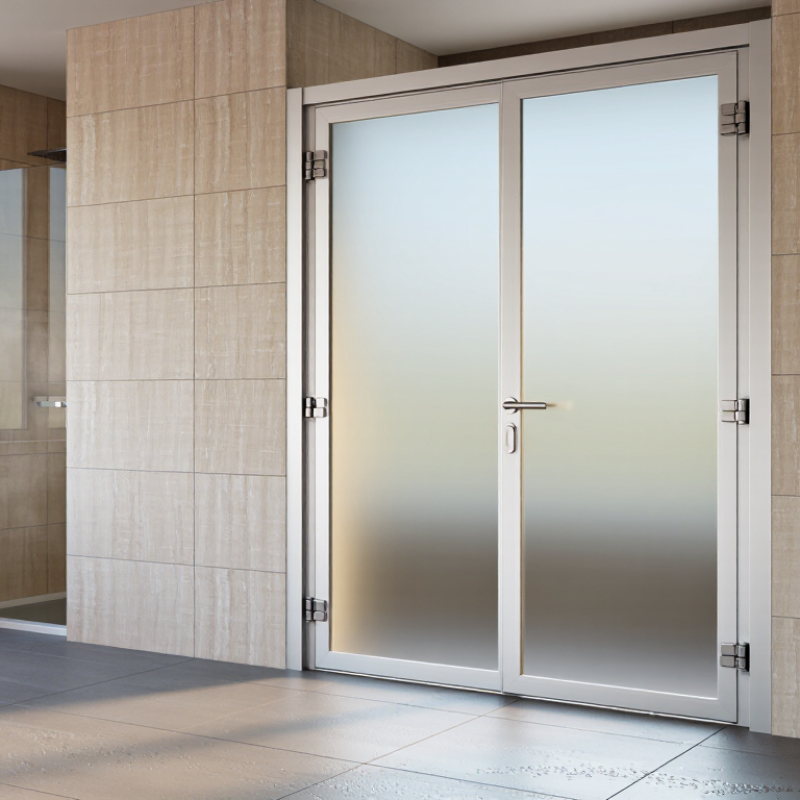
How to Choose the Best Aluminum Bathroom Door?
A bathroom door faces warm steam, splashed water, cleaning products, and repeated opening. For this environment, 6063-T5 aluminum is a practical specification to examine. Its nominal density is 2.70 g/cm³, which helps keep the frame relatively light while maintaining useful rigidity. The T5 temper means the alloy is artificially aged after cooling from an elevated-temperature process. This improves its mechanical performance, but it does not make every door equally durable.
Check the profile thickness, corner joints, drainage design, and surface treatment together. A thin frame can flex when the hinges carry a heavy glass panel. Poorly sealed corners may collect water like a small hidden tray. Ask for an alloy certificate, density data, and temper documentation before purchasing. A sample cut should show clean internal walls, not excessive voids or rough finishing. These details provide stronger evidence than a polished product photograph.
Installation still matters. Keep the lower track clear, use corrosion-resistant fasteners, and inspect the seal after several weeks of use. I have seen suitable aluminum fail early because water remained trapped near the threshold. That is easy to overlook. The 6063-T5 designation is valuable, but it is not a complete quality guarantee. Door size, wall alignment, hardware weight, and maintenance habits deserve equal attention. A careful specification may feel slower, yet it can prevent noisy movement, loose joints, and premature surface damage.
Choosing an aluminum bathroom door starts with the extrusion, not the finish. A wide frame profile gives better hinge support and room for seals. Narrow profiles may look clean, but they can twist under repeated use. Check the hinge-side channel, corner joints, and lower sill closely. These areas often reveal poor design.
ASTM B221 is a useful quality reference for aluminum extrusions. It covers alloy chemistry, temper, dimensions, and mechanical properties. However, it is not a complete door-performance certificate. Ask for the alloy, temper, wall-thickness report, and batch traceability. A practical screening range is 1.2–1.6 mm for light interior use and about 1.8–2.0 mm for heavier doors. These figures are not universal requirements. Measure the actual metal, especially around screw channels. Catalog thickness can be optimistic.
The International Aluminium Institute reports that recycled aluminum uses roughly 5% of the energy required for primary aluminum. That supports responsible material sourcing, but recycled content alone does not prove extrusion strength. Look for consistent surfaces, clean corners, and no visible tearing after cutting. The Aluminum Association’s industry statistics also show aluminum recycling remains a major supply stream, making billet traceability increasingly important. A small flaw matters. I would still request independent dimensional checks, because a polished profile can hide uneven walls, weak threads, or poor drainage design.
A bathroom door faces warm vapor, splashing water, and repeated cleaning. Its aluminum coating should meet AAMA 2604 performance requirements. This specification addresses coating durability, adhesion, color retention, and resistance to humidity. However, a compliant coating is not a waterproof system. It protects the metal surface. It does not correct poor installation.
Ask the supplier for coating documentation, pretreatment details, and dry-film thickness records. Inspect the finish closely for pinholes, scratches, and uneven edges. Small defects matter. A beautiful surface can still hide weak protection around hinges and cutouts. Experienced installers should seal those areas without blocking movement or drainage.
The sill deserves equal attention. It should slope toward the wet side and include clear drainage paths. Weep openings must remain unobstructed after installation. A door frame that traps water may corrode internally, even with a strong coating. Check the wall interface, threshold, sealant joints, and nearby floor falls together. These parts work as one system.
Do not rely on appearance alone. Ask how the design handles standing water, cleaning chemicals, and seasonal movement. In real projects, drainage details are sometimes overlooked because they are hidden after fitting. That is a weakness worth admitting and correcting before the door is installed.
When choosing an aluminum bathroom door, specify safety glass before comparing frame finishes. A 6 mm tempered panel offers a practical balance between stiffness, weight, and hardware compatibility. The Glass and Glazing Federation states that toughened glass is about four to five times stronger than annealed glass of the same thickness. That figure supports safer daily use, but thickness alone is not a complete safety plan.
Ask the supplier for documented compliance with EN 12150-1, which covers thermally toughened soda-lime safety glass. The standard includes requirements for visual quality, thermal treatment, and fragmentation performance. Check for permanent safety markings, test records, and traceable production details. Do not accept a vague “tempered glass” claim. It needs evidence.
Installation matters greatly. Edges should remain protected, and the panel must sit correctly inside compatible gaskets or channels. Misaligned hinges can create pressure at the corners. That is where problems may begin. Industry guidance repeatedly links glass failures to impact, edge damage, or poor fitting, rather than normal water exposure. A 6 mm panel is not magic. For unusually wide doors, heavy hardware, or high-use bathrooms, request a design review and confirm the door system’s load limits. EN 12150 compliance should support the selection, not replace careful measurement and professional installation.
A 6 mm tempered glass panel has an estimated mass of approximately 15 kg per square metre, based on a typical glass density of 2,500 kg/m³. It provides a practical balance between panel weight, rigidity, and safety for bathroom doors. Always verify that the finished glass complies with EN 12150 for thermally toughened safety glass.
How to Choose the Best Aluminum Bathroom Door?
Choosing an aluminum bathroom door requires more than checking its frame color. Examine the hinges, rollers, handle, screws, and corner joints closely. Hardware should resist corrosion and support the door’s weight without flexing. Open and close the door several times. It should move quietly and meet the frame evenly. Small movement matters. Ask for the hardware’s material, load rating, and replacement availability before ordering.
Seals deserve equal attention. Look for continuous silicone or EPDM seals around the sides and bottom. They should sit firmly without folds, gaps, or excessive compression. A bottom sweep can reduce splashing, but it cannot correct a badly aligned door. Measure the opening at several points, then check whether the wall is plumb and the floor is level. Installation tolerances must match the door system’s written requirements. Allowing too little space can cause binding, while too much space may weaken sealing.
Read the warranty before installation begins. Confirm coverage for the aluminum finish, hardware, seals, glass, labor, and installation-related defects. Check exclusions, maintenance duties, and the claim process. Keep measurements, invoices, and installation records. A weak warranty may look acceptable until a hinge loosens after repeated moisture exposure. I would not rely on verbal promises. I once underestimated a slightly uneven floor, and the lower seal wore faster than expected. That mistake changed how I inspect bathroom door openings.
| Evaluation Area | Specification to Verify | Practical Benchmark | How to Check Before Purchase | Why It Matters |
|---|---|---|---|---|
| Door Frame Material | Aluminum alloy grade and wall thickness | Common architectural aluminum profiles include 6063-T5 or an equivalent alloy. A residential bathroom frame commonly uses a profile wall thickness of approximately 1.2–2.0 mm, depending on the door size and design. | Request the written profile specification and confirm the measured thickness at a non-decorative section. Do not judge strength from the surface finish alone. | Appropriate alloy and section thickness help reduce frame distortion, vibration, and premature failure around hinges and screws. |
| Surface Finish | Coating or anodizing type and corrosion resistance | Suitable finishes include anodized aluminum or a properly applied powder coating intended for humid interior environments. The finish should be continuous, even, and free from bubbling, peeling, or exposed base metal. | Inspect corners, cut ends, drainage areas, and screw locations. Ask for the finish type, cleaning instructions, and any available corrosion-resistance test information. | Bathrooms expose the frame to moisture, cleaning chemicals, and mineral deposits that can damage weak or poorly applied finishes. |
| Hinges and Fasteners | Hinge material, load rating, adjustment, and screw quality | Hinges should be corrosion-resistant, correctly sized for the door weight, and firmly attached to reinforced frame sections. Stainless steel fasteners are generally preferable in wet areas to reduce rust risk. | Open and close the sample door repeatedly. Check for lateral movement, rubbing, loose screws, uneven gaps, and accessible hinge adjustment points. | Weak hinges or fasteners can cause sagging, latch misalignment, seal gaps, and difficult operation. |
| Handle and Latch | Ergonomics, corrosion resistance, and positive engagement | The handle should have smooth edges and a secure fixing method. The latch should engage fully without excessive force and should remain operable with wet hands. | Test the handle from both sides and verify that the latch aligns with the strike plate throughout the door swing. | A reliable latch improves privacy, safety, and daily usability while reducing stress on the frame. |
| Perimeter Seals | Seal material, continuity, compression, and replaceability | EPDM or another bathroom-suitable elastomer is commonly used for moisture seals. The seal should run continuously around the required edges, contact the frame evenly, and remain flexible without cracking. | Close the door on a thin sheet of paper at several points. Consistent resistance indicates contact; excessive resistance may indicate over-compression or misalignment. | Continuous seals limit splash migration, drafts, noise, and contact between dissimilar surfaces. |
| Bottom Sweep or Threshold | Water-control design and floor compatibility | A bottom sweep, drip edge, or threshold should direct water toward the wet-area drain without preventing the door from opening. The final detail must suit the floor slope and waterproofing arrangement. | Confirm the required clearance above the finished floor and check that the sweep will not drag on tiles or block drainage. | Incorrect bottom clearance can cause leakage, seal damage, difficult operation, or trapped water at the doorway. |
| Glass and Panel Compatibility | Panel thickness, safety glazing, and edge protection | If glass is used, it should be safety glass suitable for the application and installed with compatible gaskets or setting blocks. The panel thickness must match the hinge and frame design. | Check the safety-glazing marking or compliance documentation and inspect all edges for chips, cracks, or unsupported contact with metal. | Correct panel selection reduces the risk of breakage, rattling, stress concentration, and hinge overload. |
| Opening and Wall Condition | Plumb, level, square, and substrate strength | The opening should be reasonably plumb and level, with sound material available for fixing. Local building conditions may require shims or additional blocking. | Measure both diagonals, the width at the top, middle, and bottom, and the height at both sides. Check the wall with a level before ordering. | A distorted or weak opening can prevent proper sealing and may transfer movement into the frame and hardware. |
| Installation Tolerance | Specified adjustment range and fixing allowance | Many framed door systems provide only limited adjustment. As a planning benchmark, allow approximately 3–6 mm of fitting or shim adjustment per side unless the installation manual states otherwise. | Compare the measured opening with the manufacturer's required rough-opening dimensions. Confirm whether tolerances are included in the quoted door size. | Insufficient allowance can lead to forced installation, frame twist, uneven gaps, and premature seal failure. |
| Fastening and Sealant | Fixing points, compatible sealant, and drainage paths | Use corrosion-resistant screws appropriate for the substrate and a bathroom-compatible sealant. Sealant should not block designed drainage or weep paths. | Request the fixing layout and sealant type. Confirm that the installer will seal penetrations without filling intentional drainage channels. | Correct fixing and sealing prevent movement and reduce water entry behind the frame, where concealed damage can develop. |
| Water Management | Door swing, splash direction, and drain relationship | The door should open without striking fixtures and should not direct water toward the dry side. A shower door should work with the room's slope and drainage design. | Review the swing on the plan and perform a final water test after installation. Confirm that water flows toward the drain rather than pooling at the frame. | Good water management protects flooring, adjacent walls, cabinetry, and hardware from repeated moisture exposure. |
| Warranty Coverage | Coverage period, exclusions, remedy, and claim procedure | The written warranty should identify coverage for frame finish, hardware, seals, manufacturing defects, and installation separately. Wear items such as seals may have shorter coverage or be excluded. | Obtain the full warranty before purchase. Verify required maintenance, proof-of-purchase rules, geographic limits, labor coverage, and response or replacement terms. | Clear terms prevent disputes over whether a failure is a product defect, installation problem, misuse, or normal wear. |
| Maintenance Requirements | Cleaning products, lubrication, and replacement parts | Use mild, non-abrasive cleaners unless the care instructions specify otherwise. Rinse away residue and keep moving hardware clean and correctly lubricated when required. | Ask whether replacement seals, rollers, hinges, and handles remain available and whether they can be replaced without changing the complete door. | Routine maintenance extends service life and helps preserve sealing, smooth movement, and surface appearance. |
| Final Acceptance Test | Operation, alignment, sealing, and finish inspection | The installed door should open and close smoothly, latch without force, maintain even gaps, and show no visible leakage during a controlled water test. | Inspect before accepting the installation. Record photographs of gaps, hardware, finish, sealant joints, and any defects or unfinished work. | Documented acceptance provides evidence for correcting installation issues while the installer is still responsible for the work. |
A wider profile usually supports hinges better and leaves room for seals. Narrow frames may look cleaner but can twist over time. Inspect the hinge channel, corners, and lower sill. Small flaws matter.
Light interior doors often use about 1.2–1.6 mm walls. Heavier doors may need roughly 1.8–2.0 mm. These figures are practical ranges, not universal rules. Measure the actual metal near screw channels.
Request the alloy, temper, wall-thickness report, and batch traceability. ASTM B221 can help verify dimensions and mechanical properties. It does not certify complete door performance. A polished surface can hide uneven walls.
No. Recycled aluminum can reduce energy use and support responsible sourcing. It does not prove extrusion strength. Check clean corners, consistent surfaces, and cutting quality. I would still request independent dimensional checks.
Ask for AAMA 2604 coating records, pretreatment details, and dry-film thickness data. Inspect hinges and cutouts for pinholes or scratches. The coating protects the surface, not poor installation. Small defects can spread.
The sill should slope toward the wet side. Weep openings must stay clear after installation. Check the threshold, wall interface, sealant joints, and floor slope together. Water trapped inside can cause hidden corrosion.
A 6 mm tempered panel balances stiffness, weight, and hardware compatibility. Wider doors or heavy hardware may require a design review. Thickness alone is not a complete safety plan. Not always enough.
Ask for EN 12150-1 compliance records and permanent safety markings. Confirm visual quality, thermal treatment, and fragmentation performance. Edges need protection inside compatible gaskets or channels. Misaligned hinges can stress corners.
Choosing the right Aluminum Bathroom Door starts with identifying the room’s size, ventilation, humidity, and daily use. A reliable option should use 6063-T5 aluminum, with a reference density of approximately 2.70 g/cm³, to provide a balance of strength, light weight, and corrosion resistance. Compare frame profiles carefully, paying attention to wall thickness, dimensional consistency, and extrusion quality verified against ASTM B221 requirements. A durable surface finish should meet AAMA 2604 standards, while well-designed drainage paths help prevent water from collecting around the frame and threshold.
Safety and long-term performance are equally important. Select 6 mm tempered glass panels manufactured to EN 12150 requirements, and inspect hinges, handles, locks, rollers, gaskets, and seals for dependable operation and moisture protection. Before installation, confirm opening dimensions, alignment, fixing points, and allowable installation tolerances. Finally, review the warranty coverage for finishes, hardware, glass, and structural components, ensuring that the Aluminum Bathroom Door is supported by clear maintenance guidance and practical after-sales service.