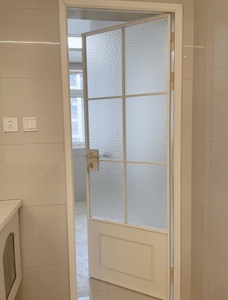
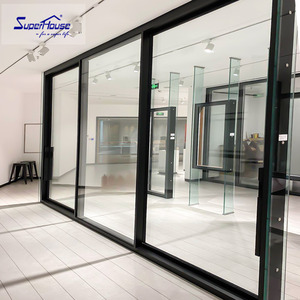
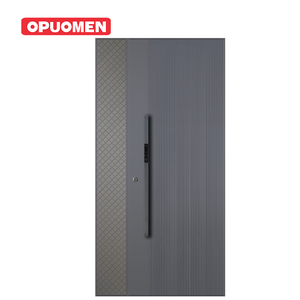
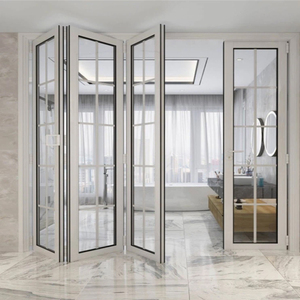
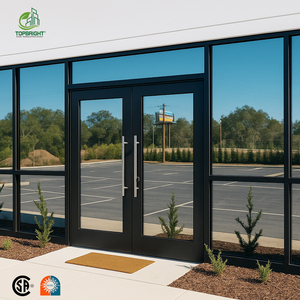
Topbright Modern Commercial Hotel Storefront Door Soundproof Aluminum Framed Double Glass
- Acoustic insulation up to Rw 42 dB
- Double tempered low-E security glass
- High-traffic hotel entry performance
Discover our comprehensive portfolio of CE-certified aluminium profiles, high-performance thermally broken fenestration, Crittall-style minimalist partitions, and impact-resistant hybrid systems tailored to rigorous European standards.
A technical deep-dive into thermal isolation barriers, mechanical stress decoupling, timber moisture stabilization, and the mandatory regulatory frameworks of the European Construction Products Regulation (CPR 305/2011).
Aluminium and natural timber exhibit vastly disparate coefficients of thermal linear expansion (αAlu ≈ 23 × 10-6/K vs. αWood ≈ 5 × 10⁻⁶/K). Rigidly binding these two substrates causes bowing, delamination, and seal degradation under extreme seasonal fluctuations.
DERCHI implements engineered composite sliding nylon-polyamide clips that maintain a continuous 5mm ventilation cavity between the external aluminium profile and the laminated timber core. This decoupled assembly permits natural dimensional movement, ensures rapid drainage of atmospheric condensation, and permanently insulates the interior timber from hygroscopic degradation.
Solid unlaminated timber is inherently susceptible to internal grain stress, twisting, and moisture checking. Our CE-certified wood profiles utilize 3-ply and 4-ply radially cut laminated timber blanks (European Larch, North American White Oak, FSC-certified Nordic Pine) bonded with waterproof D4 / EPI polyurethanes under high pressure.
Kiln-dried under micro-processor humidity management to an equilibrium moisture content of 12% ± 2%, the opposing grain orientations negate dimensional warp, maximizing structural stability across oversized sliding and casement spans exceeding 3,200mm in height.
Traditional fenestration failure stems from perimeter gasket shrinkage and water backflow under gale-force wind loads. DERCHI systems utilize continuous vulcanized central-fin EPDM seals paired with acoustic outer and inner rebated gaskets.
This triple-barrier isobaric decompression chamber neutralizes positive external wind pressures before moisture can penetrate the frame rebate, securing Class E1500 (1500 Pa) watertightness under EN 12208 and sound attenuation up to Rw 46 dB under EN ISO 717-1 for busy transit or coastal environments.
Full compliance cross-reference for project tender specifications, structural building controls, and EU Declaration of Performance (DoP) files pursuant to EN 14351-1:2006+A2:2016.
| Performance Property | European Standard | DERCHI Laboratory Achieved Level | Mandatory Baseline Requirement | Architectural Application Relevance |
|---|---|---|---|---|
| Air Permeability | EN 12207 | Class 4 (600 Pa) Certified Maximum | Class 2 or 3 | Prevents energy leakage, draft ingress, and interior humidity imbalance. |
| Watertightness | EN 12208 | Class E1500 (> 1500 Pa) Super-High | Class 7A – 9A (300–600 Pa) | Essential for exposed coastal villas, high-rise wind driving rain zones. |
| Resistance to Wind Load | EN 12210 | Class C5 / B5 (2000 Pa deflection) | Class C2 / C3 | High structural frame inertia prevents glass displacement under storm gusts. |
| Overall Thermal Transmittance (Uw) | EN ISO 10077-1 / 2 | 0.76 – 0.88 W/m²·K Passivhaus Ready | ≤ 1.30 W/m²·K (German GEG / UK Part L) | Triple low-E glazing with argon + warm edge Swisspex spacers. |
| Acoustic Attenuation (Rw) | EN ISO 717-1 | Rw 42 dB – 48 dB (with acoustic laminated glass) | Rw 32 dB | Urban hotel noise compliance, near rail networks and flight corridors. |
| Burglar Resistance | EN 1627 – EN 1630 | RC2 / RC3 Classification | RC1N / RC2N | Mushroom-cam multi-point security gearing, anti-drill plates, P4A glass. |
| Operating Durability | EN 12400 | Class 4 (20,000 to 50,000 cycles) | Class 2 (10,000 cycles) | Long-cycle structural endurance for public spaces and premium residences. |
How progressive developers, real estate investment trusts (REITs), and commercial facade contractors are aligning their supply chain strategies with shifting decarbonization mandates.
With the roll-out of the EU's Energy Performance of Buildings Directive (EPBD) recast, green building standards (LEED Platinum, BREEAM Outstanding, DGNB) require verified Environmental Product Declarations (EPD).
Procurement is aggressively pivoting toward certified hydro-powered low-carbon recycled aluminium billets (≤ 4.0 kg CO2/kg Al) coupled with FSC/PEFC-certified timbers. DERCHI's complete manufacturing chain tracks cradle-to-gate carbon metrics, enabling frictionless ESG compliance for large-scale institutional developments.
The passive window is becoming an active smart-building sensor node. Modern tenders demand concealed motorized actuators, integrated magnetic reed contacts (VdS certified) for smart intruder alarms, and dynamic automated trickle ventilation units.
DERCHI pre-wires motorized tilt-and-turn hardware and heavy-duty concealed bi-fold / lift-and-slide motors compatible with KNX, BACnet, and Apple HomeKit protocols directly inside the extrusion profiles during factory assembly.
While conventional triple glazing demands deep 44mm to 52mm glass pockets resulting in bulky profiles, next-generation VIG technology delivers central pane thermal values of Ug 0.40 W/m²·K in an 8.3mm profile thickness.
This revolutionary reduction enables ultra-minimalist heritage sightlines for historical renovation projects across London, Paris, and Amsterdam, satisfying conservation officers without compromising Passivhaus thermal efficiencies.
With 25+ years of production excellence and an intelligent 180,000 m² production complex in Foshan, China, DERCHI ranks as a Top 10 fenestration brand, engineering turnkey solutions for prestigious international projects.
Trusted by a long-term UK Schüco partner for luxury multi-villa programmes. Our automated CNC extrusion and corner-crimping lines match the most stringent European tolerances (±0.5mm), eliminating site adjustment headaches.
We do not just fabricate; we engineer. Our dedicated technical department delivers fully coordinated DWG, Revit BIM models, structural wind deflection calculations, and static anchoring plans tailored to your specific building opening schedule.
Overcome time zone barriers. Our bilingual facade engineers provide direct real-time technical consultation aligned with Central European and UK business hours, streamlining RFIs, shop drawing sign-offs, and logistics coordination.
Direct container shipments to Europe’s gateway hubs (Rotterdam, Hamburg, Antwerp, Felixstowe) protected by reinforced fumigated steel-framed crates, individual desiccant packs, and moisture-barrier vacuum packaging.
Rigorous technical clarity addressing CE certification validity, U-value calculation methods, tropicalization, condensation control, and containerized transport safety.
Every fenestration unit exported to the European Union and European Economic Area is governed by Regulation (EU) No 305/2011 (Construction Products Regulation – CPR). Our compliance is validated via Initial Type Testing (ITT) conducted by accredited notified bodies in accordance with harmonised European product standard EN 14351-1:2006+A2:2016.
Upon order placement and technical sign-off, we supply complete project-specific documentation including: (1) Official Declaration of Performance (DoP), (2) Affixed CE marking labels denoting precise air permeability, watertightness, wind resistance, and thermal transmittance values, and (3) Factory Production Control (FPC) audit documentation audited to ISO 9001 standards.
Whole-window thermal transmittance (Uw) is computed strictly following EN ISO 10077-1 and finite element analysis under EN ISO 10077-2. Our engineering calculations factor frame ratio (Uf), glazing center-of-glass performance (Ug), and the linear thermal bridge coefficient of the glass edge spacer (Ψg).
Yes. By utilizing our 88mm and 108mm architectural wood profiles (Larch or Oak), fitted with 48mm triple-glazed units (4Low-E + 18Ar + 4Clear + 18Ar + 4Low-E) featuring Swisspex Ultimate warm-edge spacers (Ψ = 0.030 W/m·K), our systems achieve certified Uw values as low as 0.76 W/m²·K, comfortably fulfilling European Passivhaus Institute guidelines.
DERCHI utilizes certified Qualicoat Class 2 (super-durable architectural powder coatings from AkzoNobel Interpon or Tiger Drylac) and Qualanod marine-grade anodizing (25 μm thickness). Our powder coatings endure 1,000+ hours of continuous neutral salt spray testing (ISO 9227) without blistering or adhesion failure.
For demanding marine projects within 500 meters of open sea water, we provide pre-anodized powder-coating systems that eliminate filiform corrosion, backed by comprehensive manufacturer weathering warranties up to 25 years against chalking, fading (ΔE ≤ 5), and peeling.
Surface condensation occurs when the interior frame temperature drops below the dew point of the indoor climate. In DERCHI alu-clad wood systems, the solid timber core functions as a natural thermal insulator with an exceptionally low thermal conductivity (λ ≈ 0.13 W/m·K).
Coupled with continuous polyamide thermal breaks separating the aluminium components and warm-edge spacer technology that raises the internal edge-of-glass temperature by up to 5°C compared to standard aluminium spacers, our systems maintain a high temperature factor (fRsi ≥ 0.70), fully eliminating mold growth risk and surface condensation according to DIN 4108-2.
We standardize on premier German hardware mechanisms including Siegenia, Roto Frank, and Winkhaus, alongside architectural Hoppe handles. These perimeter systems feature multi-point mushroom-head cams, hardened steel keeps, anti-jemmy sash locks, and integrated sash mis-handling devices.
When configured with laminated safety glazing (P4A according to EN 356) and screw-fastened glazing beads, our window assemblies are certified to European Resistance Classes RC2 and RC3 under EN 1627, offering formidable defense against forced manual entry using heavy tools, crowbars, and screwdrivers.
Standard production cycle is 25 to 35 calendar days from final CAD shop drawing sign-off and color sample approval. Ocean transit to European ports averages 28 to 35 days, with complete vessel tracking provided by our dedicated freight forwarders.
Packaging integrity is paramount: Each window sash and frame is enveloped in 3-layer protective PE film, heavy corner guards, shrink-wrapped with industrial-grade desiccants to prevent sea-humidity condensation damage, and secured inside custom-built fumigated plywood crates reinforced with internal steel dunnage to eliminate transit shifting or glass stress fractures.
Whether you are tendering for a high-end European villa development, restoring a historical urban landmark, or sourcing large-scale facade packages, DERCHI provides complete engineering support, complimentary CAD shop drawings, and competitive direct-from-manufacturer pricing.