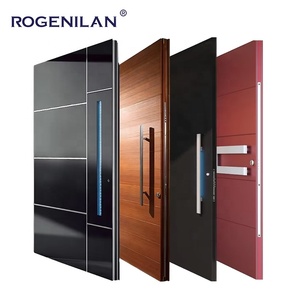
High Quality House Cast Aluminium Front Entry Swing Door Modern Residential Security
Profile AlloyA356 Pure Cast
Thermal ValueUD 1.05 W/m²K
Lock SystemMulti-Point Auto
Acoustic RatingRw 41 dB
From thermally insulated aluminum-timber compositions to blast-resistant cast aluminum security systems and oversized architectural pivot entrances, our systems are certified under EN 14351-1, CE, and AS 2047 protocols.
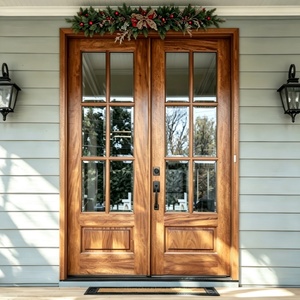
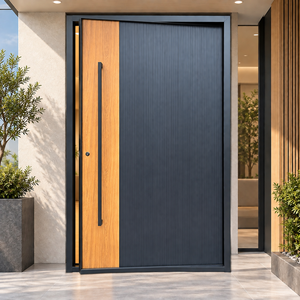
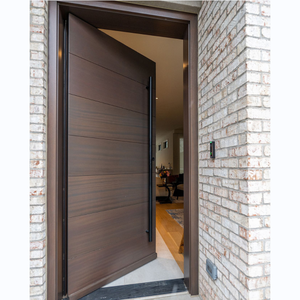
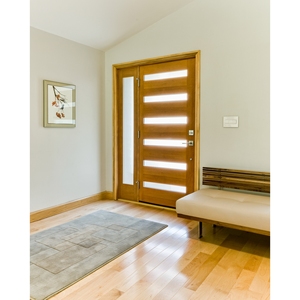
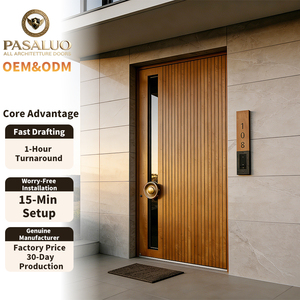
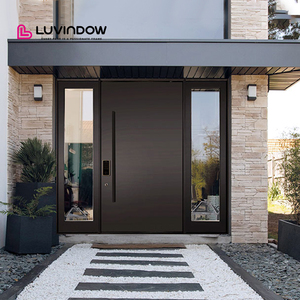
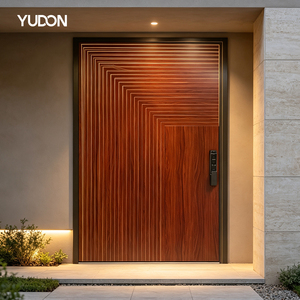
In high-end architectural envelope design, the primary entrance stands as the single most critical threshold between external atmospheric volatility and conditioned internal microclimates. Historically, developers and specification directors were forced to navigate an inherent architectural compromise: the organic warmth, acoustic dampening, and interior biophilic appeal of solid architectural hardwoods versus the structural rigidity, dimensional stability, weather resistance, and superior intrusion deterrence of metallic envelopes. Solid wood portals exposed to external humidity cyclically warp, swell, and experience fiber delamination along miter joints; monolithic aluminum systems, conversely, risk high thermal conduction and visual coldness in luxury interiors.
"Modern fenestration engineering solves the thermal-movement paradox through non-rigid structural decoupling. Cladding structural multilayer timber cores with an independent, back-ventilated 6063-T6 aluminum exo-skeleton creates an envelope component that neither shrinks in winter nor warps under intense solar exposure."
As China's leading manufacturing authority in composite aluminum-timber entrance architecture, our systems utilize a proprietary floating mechanical connector array. Instead of adhesive bonding—which fractures under the divergent thermal expansion coefficients of aluminum (23.1 × 10⁻⁶ /K) and dry timber grain (approx. 5.0 × 10⁻⁶ /K)—we incorporate sliding polyamide PA66 GF25 clips. This allows external aluminum surfaces to expand freely during extreme summer surface temperatures up to 80°C without transferring shear stresses into the internal laminated solid wood substrate, thereby guaranteeing perpetual alignment, air tightness class 4 (EN 12207), and zero latch distortion across decades of heavy operation.
Triple-layer finger-jointed timber sections kiln-dried to an exact 8%–10% moisture content. Alternating grain orientations eliminate internal cellular tension, preventing twisting even in oversized 4-meter pivot leafs.
Glass fiber-reinforced 34mm thermal insulation bars create an absolute barrier against thermal bridging. In combination with aerogel core infills, our doors attain passive house UD values down to 0.78 W/m²K.
Integrated 5-point motorized multipoint latches, anti-drill manganese plates, heavy-duty stainless steel 3D hinges, and laminated safety glass that effortlessly pass stringent EN 1627 anti-burglary test suites.
Every entrance door batch produced in our Foshan industrial facilities is tested against EN, ASTM, and AS standard testing sequences. Below is our baseline technical delivery specification for tier-1 export markets.
| Evaluation Parameter | Harmonized Protocol | DERCHI Engineering Capability | Compliance Verdict |
|---|---|---|---|
| Thermal Transmittance (UD) | EN ISO 10077-1 / DIN 4108 | 0.78 – 1.10 W/(m²·K) (Calculated via Finite Element Model) | Passive House Standard |
| Air Permeability | EN 12207 / BS 6375-1 | Class 4 (600 Pa test pressure with < 0.75 m³/h·m²) | Highest EN Class |
| Water Tightness Under Wind | EN 12208 (Method A) | Class E900 (900 Pa static water pressure without infiltration) | Severe Weather Pass |
| Resistance to Wind Load | EN 12210 / AS 2047 (N6) | Class C5 (3000 Pa wind test) / AS 2047 4500 Pa Ultimate | Hurricane / Typhoon Rated |
| Acoustic Attenuation (Rw) | ISO 717-1 / EN ISO 10140 | Rw = 38 dB to 44 dB (Depending on timber density & core) | Urban Noise Isolation |
| Burglar Resistance | EN 1627 – EN 1630 | RC2 to RC3 Standard (PAS 24 Equivalent Certified) | Secured by Design Ready |
| Corrosion Resistance (Exterior) | EN 1670 / AAMA 2605 | Qualicoat Class 2 / PVDF 3-Coat > 3000 hr salt-spray | Severe Marine Grade C5 |
Drawing from our supply chain data across the European Union, the United Kingdom, North America, and Australia, we project four pivotal shifts governing high-end door specifications through the next decade.
With the implementation of the EU's Carbon Border Adjustment Mechanism (CBAM) and strict embodied carbon reporting under UK Part Z proposals, procurement heads require verified EPDs (Environmental Product Declarations). We lead this shift by incorporating low-carbon hydropower-smelted aluminum profiles and 100% FSC-certified timber supply lines with unbroken chain-of-custody documentation.
Modernist architecture demands monumentality. Standard casement doors capped at 2.4 meters are yielding to monolithic pivot leaves reaching 4 to 5 meters in height and up to 2.2 meters in width. Fabricating these units without planar deflection requires internal carbon-fiber tension rods and multi-point concealed mechanical levelers adjustable on-site over the building's lifecycle.
Bespoke entrance portals have transformed from purely passive hardware into smart building nodes. Modern procurement bids increasingly require motorized German locks (e.g., KFV, Winkhaus, or Siegenia) paired with architectural flush handles featuring integrated optical fingerprint recognition, facial scanning, and encrypted BACnet/KNX home automation links.
The traditional approach of merely thickening aluminum profiles to achieve structural rigidity and thermal resistance has hit a technological ceiling due to weight constraints, hinge load fatigue, and architectural profile minimalism. At DERCHI, our R&D center in Foshan is pioneering three core technological innovations redefining global composite door manufacture:
By vacuum-injecting nanoporous silica aerogel blanket cores inside the central extrusion cavities, thermal conductivity (λ) drops to an unprecedented 0.015 W/m·K. This allows ultra-slim 78mm door leaves to match the thermal efficiency of bulky 110mm legacy systems.
Eliminating weak decorative PVC films that peel under intense UV, our continuous vacuum thermos-diffusion process bonds micro-micron wood pigments directly into powder-coated aluminum matrices at 200°C. The surface yields tactile natural grain feel with 30-year Florida UV weathering resistance.
Barrier-free living under modern building regulations (such as DIN 18040 or ADA standards) often compromises water-tightness. Our dynamic dual-magnetic drop seals automatically engage upon closure, resisting driving rain at 600 Pa while maintaining a completely flat 0mm floor line.
Headquartered in Foshan, Guangdong—the epicentre of global advanced aluminum extrusion and fenestration technology—Guangdong Dejiyoupin Doors and Windows Co., Ltd. (DERCHI) operates one of Asia's most sophisticated door manufacturing operations. Our 180,000 square meter integrated facility houses automated CNC machining centers, climate-regulated wood curing facilities, robotic powder-coating lines, and accredited testing laboratories.

50+ structural engineers crafting project-specific shop drawings, thermal simulation reports, and IFC/Revit models within 48 hours of tender issuance.

Air-tightness chambers, 200,000-cycle mechanical fatigue rigs, and drop-impact tests verifying every hinge and corner assembly prior to shipment.

Double PE protective films, shock-absorbing cellular edge guards, desiccants, and IPPC-stamped fumigated steel-reinforced timber crates.

Dedicated English-speaking technical project managers operating in European and North American time zones for live site coordination.
Trusted as an authorized OEM/ODM production partner by long-standing UK Schüco fabricators and international luxury developers across Europe, North America, Australia, and the Gulf region.
Clear, engineering-backed answers addressing the most common concerns raised by foreign project directors, developers, quantity surveyors, and architectural partners.
Differential thermal movement (the 'bimetal effect') occurs when the outer aluminum profile heats under solar exposure while the interior wood remains cool. We combat this using three distinct engineering strategies: (1) split-profile thermal break assemblies where polyamide strips are segmented and decoupled, (2) internal prestressing tension rods concealed within the door core that can be recalibrated via a micro-hex key, and (3) back-ventilated exterior aluminum fascia mountings on self-aligning sliders.
Every custom consignment is delivered with comprehensive documentation supporting local statutory sign-offs. For European projects, we supply Declarations of Performance (DoP) under EN 14351-1, verified CE markings, and EN 1627 RC2/RC3 test certificates. For Australian imports, we provide full AS 2047 (N4/N6 rating) and AS 1288 glazed conformance documentation. For North American sites, we supply NFRC thermal ratings and ASTM E1886/E1996 hurricane impact test reports.
We work exclusively with certified sustainably harvested hardwoods including European White Oak (FAS Grade), Burma Teak, American Black Walnut, Meranti, and Siberian Larch. Raw lumber undergoes a two-stage seasoning process: a 90-day natural conditioning period followed by computer-controlled vacuum dehydration to stabilize internal moisture between 8% and 10%. This prevents internal cell collapse and guarantees stability across contrasting climatic zones.
Upon approval of final CAD shop drawings and hardware scheduling, standard production takes 25 to 35 business days. Specialized cast aluminum panels or oversized motorized pivot doors requiring bespoke extrusion profiles may require 40 business days. Transit time via ocean freight from Shenzhen or Guangzhou ports ranges from 22–28 days to Western European hubs (Rotterdam, Felixstowe, Hamburg) and 14–18 days to the US West Coast.
Export logistics is treated as an extension of manufacturing precision. Each door panel is wrapped in non-static PE foam, followed by vacuum-sealed moisture-barrier film containing silica gel desiccant bags. Corners are reinforced with high-density EVA edge protectors. The completed assembly is secured within a heavy-gauge, fumigated plywood crate with integrated internal timber clamping ribs to guarantee zero structural movement inside shipping containers.
Yes. We pre-wire, drill, and bench-test all motorized hardware in our factory before disassembling for transport. We integrate concealed power transfers (such as Dormakaba or Simonswerk cable conduits), motorized multi-point locks (KFV Genius, Winkhaus blueMatic), and certified facial/biometric readers (Ekey dLine, SimonsVoss). Systems arrive plug-and-play with pre-configured schematic wiring diagrams for your on-site electrician.
For coastal and marine environments located within 1 km of the shoreline, we mandate our C5-M extreme marine surface preparation. Aluminum surfaces receive a chemical pre-treatment and a minimum 60–80 micron multi-coat PVDF (polyvinylidene fluoride) fluorocarbon finish compliant with AAMA 2605 or Qualanod marine anodizing (25μm). These coatings carry a 20- to 30-year warranty against chalking, fading, cracking, and salt-spray pitting.
Our engineering team designs sub-frame mounting channel systems that provide ±15mm horizontal and vertical site tolerance adjustments. We provide heavy-duty 3D adjustable concealed hinges (Simonswerk Tectus or SFS Intec) that allow fine 3-axis operational alignment on site after all facade and flooring settlement has taken place, ensuring airtight perimeter contact even if rough openings vary.
Whether you require standard thermally broken casement doors or bespoke 4-meter cast aluminum motorized pivot portals, our Foshan engineering studio delivers full CAD shop drawings and turnkey commercial quotations within 48 hours.