Featured Aluminum Clad French Doors & Architectural Entrance Systems
Manufactured from precision-extruded 6063-T6 architectural alloy and select structural hardwoods, DERCHI’s French door systems merge classic elegance with rigorous thermal envelope performance.
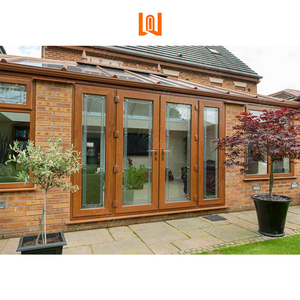
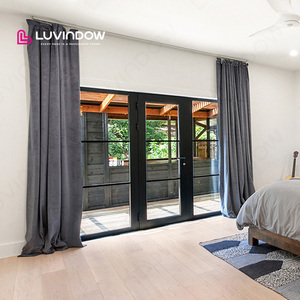
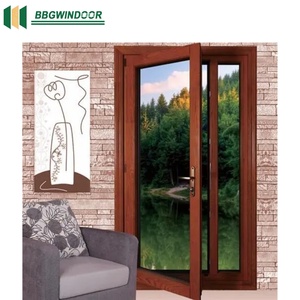
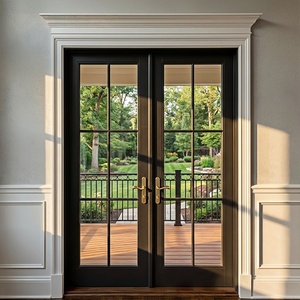
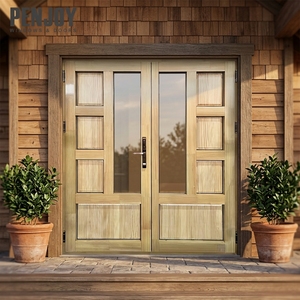
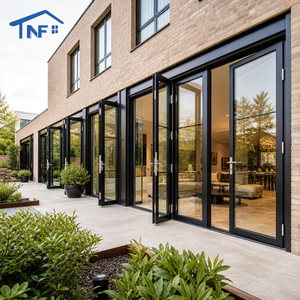
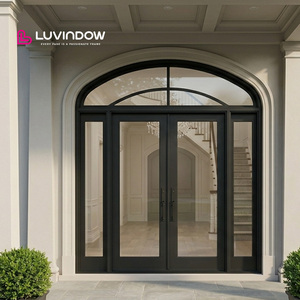
Anatomy of Industrial-Grade Aluminum Clad French Doors
Aluminum clad wood doors represent the pinnacle of fenestration engineering. By combining the low maintenance and structural stability of high-tensile exterior aluminum cladding with the interior warmth and organic insulation of furniture-grade hardwoods, this composite system solves the primary failure modes of traditional timber and vinyl doors.
Thermal Decoupling & Polyamide PA66
DERCHI integrates multi-cavity, glass-fiber reinforced Polyamide 66 (PA66 GF25) thermal barrier strips between exterior aluminum sub-frames. This prevents conductive bridge transfer, eliminating internal condensation during severe frost cycles and lowering thermal conductivity to comply with stringent European EnEV / GEG and North American ASHRAE 90.1 baselines.
Independent Floating Clip Connectors
Aluminum and solid hardwoods possess radically divergent coefficients of linear thermal expansion. DERCHI utilizes engineered composite floating snap-clips that decouple the external aluminum envelope from interior oak, larch, or walnut members. This dynamic connection allows the materials to expand and contract independently without stress warping or seal rupture.
Continuous EPDM Triple Sealing
Air-permeability and water tightness are maintained via co-extruded automotive-grade EPDM (ethylene propylene diene monomer) continuous foam gaskets. Utilizing seamless vulcanized corner joints and multi-point perimeter compression locks, our French doors systematically achieve Class 4 Air Permeability (EN 12207) and Class E900 Water Tightness (EN 12208).
| Performance Metric | International Standard | DERCHI Engineering Value | Commercial Compliance Status |
|---|---|---|---|
| Overall U-Value (UD) | EN ISO 10077-1 / 2 | 0.80 – 1.20 W/(m²·K) (Triple Low-E + Warm Edge) | Passive House Ready |
| Burglar & Intrusion Resistance | EN 1627 / RC2 – RC3 Baseline | Continuous multi-point locking + Anti-lift hinge hooks | PAS 24 / RC2 Certified |
| Wind Pressure Resistance | AS 2047 / ASTM E330 / EN 12210 | Design Load up to Class C5 (3000 Pa) / AS 2047 N6 | Coastal / High-Rise Rated |
| Acoustic Attenuation (Rw) | ISO 717-1 / ASTM E413 | Rw = 36 dB to 44 dB (Using Laminated PVB/Acoustic Panes) | Urban Soundproof Approved |
| Extrusion Alloy & Finish | AAMA 2605 / Qualicoat Seaside Class 2 | 6063-T6 Precision Alloy; 25-Year Fluorocarbon (PVDF) | Corrosion Class C5-M |
Future Procurement Trends for Aluminum Clad Doors
Architectural fenestration procurement is moving from transactional unit purchases to integrated building envelope solutions. B2B importers, property developers, and architectural contractors must prepare for three pivotal structural shifts transforming the aluminum clad door industry over the next five years.
Sub-0.8 Uw Thermal Regimes
With the tightening of UK Part L amendments, the European Union Energy Performance of Buildings Directive (EPBD), and North American net-zero mandates, standard double-glazed timber-clad assemblies are rapidly becoming obsolete. Procurement schedules must anticipate structural depths of 85mm+ accommodating triple-pane krypton or argon-injected insulated glass units (IGU) featuring dual low-emissivity coatings.
Super-Format Sashes & Concealed Hinges
High-end residential projects now demand clear visual openings surpassing traditional 2.4-meter thresholds, regularly specifying French doors with single leaf heights up to 3.2 meters. Achieving stability in such oversized configurations requires internal carbon steel corner-crimped reinforcers, heavy-duty 3D concealed barrel hinges with bearing capacities exceeding 250kg, and flush threshold drain integrations.
Biometric & Smart Building Integration
High-security residential construction demands the eradication of conventional keys. Factory-installed concealed motorized mortise locks, integrated RFID/biometric fingerprint scanner faceplates, and KNX/RS-485 smart home bus communication protocols are becoming baseline procurement specifications, requiring door suppliers to possess comprehensive in-house mechatronic assembly expertise.
Why Engineering Firms & Developers Partner with DERCHI
Based in Foshan, the epicentre of China's advanced aluminum processing industry, Guangdong Dejiyoupin Doors and Windows Co., Ltd. (DERCHI) operates as a Tier-1 integrated manufacturing enterprise serving commercial, residential, and institutional construction worldwide.
180,000 m² Direct Mega-Plant
Unlike trading intermediaries, our expansive Foshan production complex houses dedicated CNC profile-machining centers, automated electrostatic powder coating lines, and computerized kiln-drying wood processing cells with over 600 full-time specialists.
Proven International Record
Selected by an established UK Schüco partner for multi-villa luxury schemes and certified to Australia AS 2047 N6 (the ultimate cyclonic testing criteria), DERCHI’s engineered units are verified across demanding jurisdictions throughout the UK, Europe, the Americas, and Oceania.
Free Detailed CAD Shop Drawings
Our dedicated façade engineering team transforms raw architectural sketches and door schedules into verified structural CAD shop drawings, connection detail prints, and glass calculation sheets—eliminating on-site coordination errors before production begins.
CET/GMT Responsive Desk
We solve cross-border supply chain friction. Our sales engineers maintain direct communication synchronized with European and American operational working hours, supplying live production monitoring, quality control videos, and door schedule updates.
Frequently Asked Architectural & B2B Sourcing Questions
Clear, definitive technical answers addressing lead times, compliance verification, and structural parameters when sourcing custom aluminum clad French doors from China.