Flagship High-Performance Window & Door Assemblies
Every unit is precision-extruded from 6063-T6 virgin aluminum billet, integrated with thermal barrier breaks, EPDM gasket vulcanization, and advanced hardware mechatronics.
1. The Mechanical Physics and Kinetic Engineering of Aluminum Tilt and Turn Systems
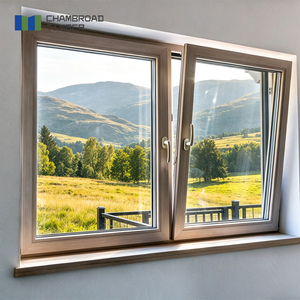
In modern fenestration engineering, the aluminum tilt and turn window represents the zenith of dual-mode building envelope mechanics. Originally standardized in Central Europe and now universally embraced across luxury residential, educational, and commercial envelopes globally, the tilt-turn system incorporates a sophisticated peripheral gear drive mechanism operated via a single ergonomic handle.
When the handle is oriented in the downward 6 o'clock position, peripheral locking mushroom cams engage into hardened steel strike plates situated around the perimeter of the frame, exerting uniform mechanical compression against three independent tiers of vulcanized EPDM (Ethylene Propylene Diene Monomer) or silicone gaskets. When rotated 90 degrees to the horizontal 9 o'clock position, the upper scissor-stay hardware disengages while bottom corner pivots stay locked, allowing the sash to swing inwardly like a traditional casement door for complete unhindered ingress, egress, and safe glass maintenance. Rotating the handle upward to the vertical 12 o'clock position re-engages the side locking mechanisms while pivoting the upper scissor hinge, tilting the top of the sash inward at a calibrated 15-degree angle for draft-free micro-ventilation and displacement cooling.
Multi-Chamber Thermal Barriers
Utilizing high-density Polyamide PA66 GF25 (25% glass fiber reinforced) structural thermal breaks measuring up to 34mm in depth. This eliminates thermal bridging between exterior structural aluminum and interior architectural trims, delivering condensation-free fenestration in sub-zero climates.
Concealed Heavy-Duty Hardware
Engineered hardware options utilizing concealed hinge axes capable of supporting sash dead loads up to 300 kg (660 lbs). Hidden hinges prevent thermal break puncture, preserve continuous perimeter gaskets, and deliver minimalist aesthetic sightlines.
Pressure-Equalized Drainage
Multi-stage pressure-relief drainage chambers incorporate concealed weep paths with one-way baffled flapper valves. This prevents wind-driven rain siphonage even during severe typhoons and storm surges reaching hurricane-force wind loads (up to 4500 Pa).
2. Comprehensive Fenestration Performance Comparison Matrix
Architects, façade consultants, and general contractors evaluate window typologies based on structural deflection, thermal transmittance ($U$-values), acoustic dampening ($R_w$/STC), and life-cycle operational durability. The following empirical testing matrix illustrates how precision aluminum tilt and turn assemblies outclass conventional alternatives:
| Performance Metric | Standard Aluminum Slider | Traditional Outward Casement | Precision Aluminum Tilt & Turn | Compliance Standard |
|---|---|---|---|---|
| Thermal Transmittance ($U_w$) | 2.6 – 3.8 W/(m²·K) | 1.6 – 2.2 W/(m²·K) | 0.78 – 1.20 W/(m²·K) | EN ISO 10077-1 / NFRC 100 |
| Air Permeability | Class 2 (300 Pa leakage) | Class 3 (600 Pa) | Class 4 (≥ 600 Pa sealed) | EN 12207 / ASTM E283 |
| Water Resistance | 150 – 300 Pa | 300 – 450 Pa | Class E900 (≥ 900 Pa) | EN 12208 / ASTM E331 |
| Acoustic Insulation ($R_w + C_{tr}$) | 28 – 32 dB | 34 – 38 dB | 42 – 48 dB (with Laminate) | EN ISO 717-1 / ASTM E413 |
| Burglar Resistance | Standard latch (Low) | Single/Twin cam points | RC2 / RC3 (Multi-point cam) | EN 1627 / PAS 24 |
| Cleaning Safety & Ingress | Exterior scaffolding required | Exterior access risky | 100% Interior maintenance | OSHA / EU Safety Guidelines |
3. Future Procurement & Technological Trends in Aluminum Tilt and Turn Windows (2025–2035)
As the international construction industry accelerates toward Net-Zero carbon buildings, decarbonized supply chains, and automated building management systems (BMS), the global procurement criteria for aluminum tilt and turn fenestration are undergoing profound systemic changes.
Low-Carbon Circular Aluminum
Procurement mandates across Europe and North America increasingly enforce EPD (Environmental Product Declaration) filings. Sourcing primary billets extruded using hydro-electric energy and recycled post-consumer scrap cuts embedded carbon from 18 kg CO2/kg Al to below 4.0 kg CO2/kg Al.
BMS Actuated Mechatronics
Concealed 24V linear DC drives integrated within the sash profile enable automated night purging, carbon-dioxide-triggered displacement venting, and weather-station sensor integration without disrupting interior visual aesthetics.
Passivhaus Compliant Glazing
Triple and quadruple glazing cavities filled with 90% Argon or Krypton gas, warm-edge composite hybrid spacers (e.g., Technoform), and double Low-E magnetron sputtering Coatings drive solar heat gain coefficients (SHGC) and U-factors to certified Passive House standards.
High-Wind & Hurricane Hardening
Rapid climate shifts require high cyclic fatigue tolerances and resistance against dynamic missile impacts. Thickened aluminum wall extrusions (≥ 2.0 mm to 3.0 mm) combined with SentryGlas® (SG) ionoplast interlayers withstand extreme gust pressures up to 6.5 kPa.
4. B2B Factory Audit & Quality Verification Framework for Commercial Specifiers
Direct factory procurement from China provides massive cost-to-performance advantages for general contractors, property developers, and window distributors. However, ensuring strict compliance with local building codes requires an exhaustive multi-stage factory audit methodology:
A. Primary Extrusion Metallurgy: Verify that the manufacturing plant utilizes certified 6063-T6 or 6060-T6 aluminum alloys compliant with EN 755-9 and GB 5237 standards. Recycled billet remelts containing iron and copper impurities must be strictly barred due to premature intergranular corrosion and diminished anodizing/powder-coating adhesion.
B. Hydraulic Corner Crimping and Structural Resin Injection: High-integrity tilt and turn window frames should not rely solely on simple mechanical screw corners. Professional factories utilize CNC dual-head automatic crimping machines paired with cast aluminum internal corner cleats and stainless steel alignment T-brackets. During assembly, two-component polyurethane corner adhesives (such as OTTO-CHEMIE or Weiss Cosmofen) must be injected into the internal chambers to create permanent, hermetically sealed, rigid joints that prevent sash sagging over 30-year design cycles.
C. Surface Treatment Guarantees: Coastal and high-humidity applications demand Qualicoat Class 2 (superdurable polyester powders with 3-year Florida weathering benchmarks) or AAMA 2605 (PVDF fluoropolymer 70% Kynar 500 resin coatings) that offer minimum 15 to 20-year non-chalking, non-fading guarantees against intense UV radiation and airborne saline exposure.
D. Hardware Origin and Cycle Endurance: Specify hardware systems from established manufacturers such as Siegenia, Roto Frank, Sobinco, or qualified Tier-1 domestic equivalents engineered for at least 25,000 continuous opening and tilt cycles under full sash weight without hinge pin binding or strike-plate degradation.

Why Leading Global Contractors Partner with Guangdong Dejiyoupin (DERCHI)
Guangdong Dejiyoupin Doors and Windows Co., Ltd. (DERCHI) stands among China's top ten recognized premium architectural window and door manufacturing enterprises. Operating from Foshan—the global epicenter of advanced aluminum extrusion—our automated facility bridges the gap between competitive Asian manufacturing scale and rigorous Western architectural standards.
- Schüco-Level Fabricator Track Record: Chosen by prominent UK building partners and European general contractors for multi-villa and boutique hotel developments requiring rigorous thermal compliance.
- Global Certification Portfolio: Fully verified by CE (EN 14351-1), ISO 9001, AS 2047 N6 (Australia's highest wind resistance classification), CSA (Canada), and UL fire-rated standards.
- Dedicated Overseas Project Engineering: Multilingual technical support aligned with GMT, CET, and EST time zones, providing free parametric CAD shop drawings, glass stress analysis, and structural wind-load calculations.
- Complete Heavy-Duty Crated Packaging: Fully encapsulated seaworthy export plywood crates, moisture desiccants, and edge corner protectors ensuring zero transport damage to European and American deepwater ports.
Frequently Asked Questions by Commercial Specifiers
Clear, authoritative technical answers addressing engineering parameters, minimum order quantities, shipping logistics, and compliance documentation.
How does DERCHI guarantee compliance with European EN 14351-1 and UK Building Regulations Part L?
Every commercial order is accompanied by our verified Declaration of Performance (DoP) and Factory Production Control (FPC) documentation under CE marking standards. Our thermal engineers run finite element frame simulations according to EN ISO 10077-2 to confirm exact whole-window $U_w$ values, center-of-glass $U_g$, and linear thermal bridge $\Psi$-spacers based on your project's specific dimensions and glass build-ups.
What are the structural maximum sash dimensions and glass weight capacities for tilt & turn units?
Utilizing our reinforced 75mm and 85mm architectural profile series paired with heavy-duty German concealed scissor hinges, our maximum single-sash operable dimensions reach 1600mm (width) by 2800mm (height) with maximum sash dead loads of 300 kg (660 lbs). For oversized architectural glazed openings, we incorporate structural silicone wet-glazing techniques to bond the insulated glass unit directly to the aluminum sash profile, enhancing racking resistance.
How do aluminum tilt and turn windows compare to UPVC systems in life-cycle cost analysis?
While UPVC initial material costs are lower, commercial specifiers choose aluminum due to its superior structural modulus of elasticity (70,000 MPa for aluminum vs. approx. 3,000 MPa for UPVC). Aluminum resists thermal warping, UV degradation, and joint embrittlement, maintaining frame squareness and airtightness over a 40+ year lifecycle, compared to 15–20 years for vinyl frames, resulting in a substantially lower total cost of ownership (TCO).
Can you provide custom RAL colors, anodized bronze finishes, and dual-color split profiles?
Yes. Our in-house vertical powder coating and fluorocarbon lines offer the complete international RAL Classic palette, Tiger Drylac architectural collections, and anodized architectural finishes up to 25 microns (Class 1). Because our profiles are assembled via knurling and rolling PA66 thermal barrier strips, we can provide dual-color configurations (e.g., architectural textured Anthracite Grey RAL 7016 externally, and warm Signal White RAL 9003 or custom anodized bronze internally).
What is the factory lead time, and what are the export shipping logistics?
Following CAD shop drawing sign-off and glass confirmation, standard manufacturing requires 25 to 35 calendar days. For project orders requiring custom extrusion dies or unique anodizing finishes, lead times range from 40 to 45 days. We coordinate full container load (FCL) shipping directly to major international ports including Rotterdam, Hamburg, Felixstowe, Long Beach, and Sydney, with complete ocean bill of lading, fumigation certificates, and customs documentation.
What anti-burglary and forced-entry security ratings can DERCHI tilt and turn assemblies achieve?
When configured with multi-point perimeter steel mushroom cams, anti-drill hardened lock escutcheons, heavy-duty interlocks, and P4A / P5A laminated security glazing (compliant with EN 356), our aluminum tilt and turn assemblies achieve European RC2 and RC3 security ratings (EN 1627-1630) and PAS 24 certification, providing robust physical deterrence against forced-entry attempts.